
 EN-US
EN-US  TR-TR
TR-TR 
A new bill, introduced in a fallen senator’s name, just replaced the version everyone had been tracking. The tariff mechanism that once put Türkiye in the same bracket as China is now built around a five-country list — and Türkiye isn’t currently on it. That is good news, not a reason to stop watching. The list resets every 180 days, and Türkiye’s own import data is exactly what would move it back on.
Where things stand — 21 July 2026
On 16 July 2026, Senators Richard Blumenthal (D-CT), Darline Graham (R-SC), Roger Wicker (R-MS), and Jeanne Shaheen (D-NH) introduced S.5025, the Lindsey O. Graham Sanctioning Russia Act of 2026 — a new bill that replaces the S.1241 text this firm has been tracking since April 2025. It launched with more than 60 bipartisan cosponsors and, per recent reporting, 62 senators now committed to its passage — enough, in principle, to overcome a filibuster. The bill sits in the Senate Banking, Housing, and Urban Affairs Committee. No floor vote is scheduled.
The legislation is named for Senator Lindsey Graham, the bill’s original architect, who died unexpectedly on 11 July 2026 — hours after announcing that he had secured White House agreement on the text during what would be his final trip to Ukraine. His sister, Darline Graham, was appointed to his South Carolina seat and is now a lead cosponsor of the bill carrying his name.
Türkçe Özet
16 Temmuz 2026'da ABD Senatosu'na sunulan S.5025 (Lindsey O. Graham Rusya Yaptırımları Yasası 2026), daha önce takip edilen S.1241 metninin yerini almıştır. Yeni tasarı, orijinal %500'lük genel tarife yerine, yalnızca Rus ham petrolünün ve doğal gazının en büyük beşer alıcısını hedefleyen, %100 tavanlı ve 180 günde bir güncellenen bir mekanizma getirmektedir. Senato yetkilileri tarafından paylaşılan verilere göre Türkiye şu an için bu listelerde yer almamaktadır — ancak Türkiye 2025'te Rusya'nın en büyük üçüncü ham petrol alıcısıydı ve Tupraş İzmit rafinerisi 2026'nın ikinci çeyreğinde yaklaşık %60 oranında Rus ham petrolü işlemeye devam etmiştir. Liste her 180 günde bir yenilendiğinden, Türkiye'nin konumu kalıcı değildir. HERDEM, Türk enerji, dış ticaret ve bankacılık şirketlerine; tedarik kaynaklarını belgelemelerini, Rusya bağlantılı bankacılık ilişkilerini gözden geçirmelerini ve olası bir muafiyet başvurusuna şimdiden hazırlanmalarını tavsiye etmektedir. Bu konudaki gelişmeleri yakından takip ediyoruz.
The single most consequential change in the new bill is not a provision Türkiye needs to fear — it’s one Türkiye should watch closely. The original S.1241 proposed a blanket 500% tariff on any country purchasing Russian crude, petroleum products, natural gas, or uranium, a definition broad enough to capture roughly sixty countries, Türkiye included. S.5025 replaces that blanket approach with a narrower, mechanical one: a maximum 100% tariff applied only to the five largest purchasers of Russian crude and the five largest purchasers of Russian natural gas, recalculated every 180 days. As of the bill’s introduction, neither list includes Türkiye.
How the New Mechanism Actually Works
Understanding why Türkiye is currently outside the tariff’s scope requires understanding what the scope actually is now. This is a material redesign, not a cosmetic softening.
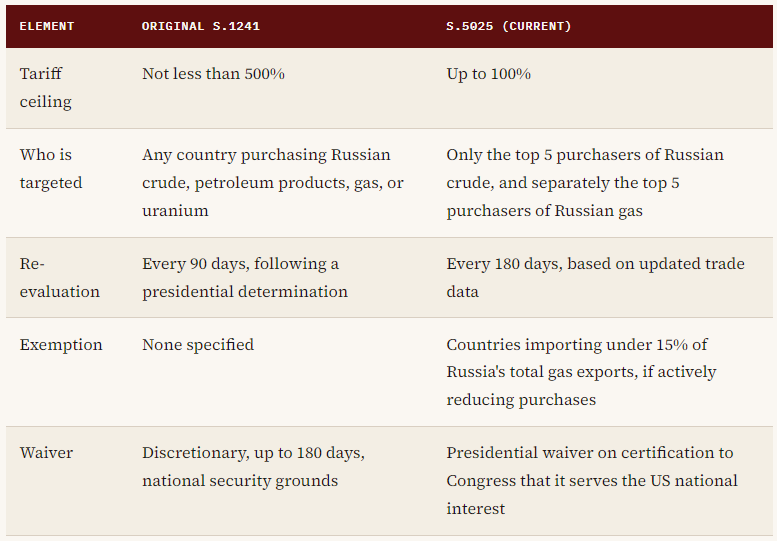
According to figures Senate aides shared with reporters at introduction, the current top-5 crude list is China, India, Slovakia, Hungary, and Azerbaijan. The current top-5 gas list is China, France, Japan, Hungary, and Belgium. Türkiye does not appear on either list under this data.
The House Track Still Matters
S.5025 is not the only version in play. The House companion, H.R.2548, introduced by Ukraine Caucus co-chairs Brian Fitzpatrick (R-PA) and Mike Quigley (D-IL), carries 155 cosponsors and has not yet been reconciled with the Senate’s narrower approach. Fitzpatrick has publicly committed to carrying the legislation through in Senator Graham’s honor. If the House version retains language closer to the original blanket tariff, any eventual conference process between the two chambers becomes the moment that matters most — and a bill that looks settled in the Senate can still change materially before it reaches the President’s desk.
Why Türkiye Isn’t on It — and Why That’s Not the Same as Being Safe
Türkiye’s absence from the current lists is not an accident of drafting; it reflects a real shift in Turkish import behaviour over the past eight months. Turkish refiners began diversifying away from Russian Urals crude well before this bill existed, largely in response to the EU’s ban on fuel refined from Russian oil, which took effect at the end of January 2026, and to US blocking sanctions on Rosneft and Lukoil imposed in October 2025. Shipping data has shown Türkiye’s Urals imports falling sharply — by roughly 100,000 barrels per day in a single month at one point — with Kazakh CPC Blend and Iraqi Basrah crude taking up the slack.
That diversification is precisely why Türkiye is not one of the world’s top five buyers of Russian crude today. But the margin is not wide, and it is not fixed. Türkiye was the third-largest buyer of Russian seaborne crude globally in 2025, behind only India and China, at roughly 11.3% of total volume. Tupras’ İzmit refinery was still running close to 60% Russian feedstock as recently as the second quarter of 2026. The SOCAR-linked STAR refinery, by some estimates, remains almost entirely dependent on Russian crude. None of that disappears because a Senate aide’s list, compiled at a single point in time, happens to place five other countries ahead of Türkiye.
The list resets every 180 days. Türkiye’s position on it is a function of trade volumes that Turkish companies are, in aggregate, actively producing — which means it is also a function Turkish companies can actively manage.
What Could Move Türkiye Back Onto the List
- A rebound in Turkish Russian-crude imports. Refiners have diversified under EU pressure, not under a US legal obligation. If Kazakh or Iraqi grades become more expensive or less available, the economic incentive to revert toward discounted Russian barrels remains.
- Faster diversification elsewhere. The list is relative. If India or China reduce their own Russian purchases faster than Türkiye does, Türkiye’s unchanged or growing volume could push it up the ranking without Türkiye’s absolute imports changing at all.
- Natural gas volumes. Türkiye is a substantial buyer of Russian pipeline gas via TurkStream and Blue Stream. It is not on the current top-5 gas list, but gas volumes were not the focus of most contemporaneous reporting on this bill, and this is a category we are actively monitoring for the next data refresh.
The Legal Point Worth Understanding, Not Just the Political One
It matters that S.5025 carries its own statutory tariff authority, separate from the executive branch’s general trade powers. On 20 February 2026, the US Supreme Court ruled in Learning Resources, Inc. v. Trump that the International Emergency Economic Powers Act does not authorize presidential tariffs, since IEEPA’s language empowering the President to “regulate” imports does not meet the clear-delegation standard the Constitution requires for the federal government’s taxing power. A tariff imposed by congressional statute, like the one S.5025 would create, does not face that same constitutional vulnerability. For a Turkish company weighing how durable any future US tariff exposure might be, that distinction is not academic — a S.5025-based tariff, if enacted, is far harder to unwind through litigation than the 2025 IEEPA-based tariff regime was.
What’s Actually at Stake in Dollar Terms
One detail is easy to miss and worth stating plainly: the tariff, if triggered, would not apply only to energy-related trade. It applies to all goods a listed country exports to the United States, regardless of sector. Türkiye’s total goods exports to the US were approximately $16.4 billion in 2025 — spanning machinery, jewelry and precious metals, electronics, automotive parts, and textiles, alongside energy products. A 100% tariff triggered by a top-5 gas or crude ranking would not stay contained to the refining sector; it would land on every Turkish exporter selling into the US market, most of whom have no connection whatsoever to Russian energy sourcing. That asymmetry — a determination driven by refinery-level import data, with consequences borne by the entire Turkish export base — is the reason this bill belongs on the radar of trade-focused clients as much as energy and banking ones.
What Herdem Recommends: A Practical Compliance and Monitoring Programme
Türkiye’s current position outside the tariff’s scope is an opportunity, not a reason to stand down. The companies best placed to benefit from that position — and to respond quickly if it changes — are the ones building the following now, while there is no active determination to react to.
- Establish a legislative monitoring cadence tied to the 180-day cycle.Track the Senate Banking Committee’s actions on S.5025, and build an internal calendar around the bill’s own 180-day re-evaluation mechanism so that any shift in the top-5 rankings is caught immediately, not discovered after the fact.
- Audit and document current crude sourcing in real time.Maintain an up-to-date, evidentiable breakdown of Russian-origin versus non-Russian-origin feedstock by volume and by refinery. This is the same data a Senate aide would cite to justify adding or removing Türkiye from the list — a company that can produce it credibly and quickly is in a far stronger position, whether engaging with Turkish regulators, US correspondent banks, or US counsel.
- Continue, and where possible accelerate, diversification away from Russian crude.The gains already made with Kazakh CPC Blend and Iraqi Basrah crude are the reason Türkiye is not currently exposed. Treat that diversification as a floor to maintain, not a milestone to reverse once market conditions shift.
- Map correspondent banking exposure to the named Russian financial institutions.Independent of the tariff mechanism, S.5025 retains blocking sanctions on the Central Bank of the Russian Federation, Sberbank, and Gazprombank, along with a prohibition on transfers involving the Russian government. Turkish financial institutions should identify any remaining correspondent or clearing relationships touching these entities and plan an orderly wind-down path now.
- Build a waiver-readiness file before it is needed.Should Türkiye’s position change at a future 180-day review, the statute allows the President to waive tariffs on certification to Congress that doing so serves the US national interest. Companies and, where appropriate, industry associations should prepare the kind of documentation — supply chain diversification evidence, energy security context, alliance considerations — that would support a waiver request, rather than starting that process from zero after a determination is made.
- Review contractual and trade-finance exposure to shadow-fleet-linked vessels.S.5025 retains and strengthens sanctions on Russia’s shadow fleet and any vessel or person facilitating sanctions evasion. Charterparties, letters of credit, and insurance arrangements touching Russian-origin cargo should be screened against updated vessel designations as a routine, not exceptional, compliance step.
- Keep natural gas import volumes under separate review.Türkiye’s exposure through TurkStream and Blue Stream pipeline gas has not been the focus of public reporting on this bill to date. Companies with material Russian gas dependency should not assume the crude-oil analysis above applies equally to gas and should treat this as an open question pending the next data disclosure.
- Engage counsel before, not after, the next 180-day recalculation.The value of legal advice on a mechanism like this is almost entirely in the lead time it buys. A company that asks HERDEM for a sourcing and exposure review in the third or fourth quarter of a 180-day cycle has options a company that asks after a determination does not.
What We’re Watching Next
Senate Banking Committee action on S.5025; any movement toward a floor vote; the next scheduled 180-day recalculation of the top-5 crude and gas lists; clarification of how Turkish pipeline gas volumes factor into the gas-purchaser ranking; and the bill’s progress relative to the companion House measure. HERDEM will issue a follow-up alert on any of these developments.
Frequently Asked Questions / Sıkça Sorulan Sorular
What is the difference between S.1241 and S.5025?
S.1241 was the original Sanctioning Russia Act, introduced in April 2025. It was replaced in July 2026 by S.5025, named for Senator Lindsey Graham, which restructures the tariff mechanism from a blanket 500% rate to a 100% rate applied only to the top five purchasers of Russian crude and gas.
S.1241 ile S.5025 arasındaki fark nedir?
S.1241, Nisan 2025’te tanıtılan orijinal yasa metnidir. Temmuz 2026’da, Senatör Lindsey Graham anısına adlandırılan S.5025 ile değiştirilmiştir. Yeni metin, %500’lük genel tarifeyi, yalnızca Rus ham petrolü ve doğal gazının en büyük beş alıcısını hedefleyen %100’lük bir tarifeyle değiştirmektedir.
Is Türkiye currently a target of US secondary sanctions under this bill?
Not under the current top-5 rankings disclosed by Senate aides. Türkiye does not appear on either the crude or gas purchaser lists as of the bill’s introduction. That position is reassessed every 180 days and is not guaranteed to hold.
Türkiye bu yasa kapsamında ABD’nin ikincil yaptırım hedefinde mi?
Senato yetkilileri tarafından açıklanan mevcut ilk beş listesine göre hayır. Türkiye, yasanın tanıtıldığı tarihte ne ham petrol ne de doğal gaz alıcıları listesinde yer almaktadır. Ancak bu değerlendirme her 180 günde bir yenilenmektedir ve kalıcı bir güvence değildir.
What should Turkish companies do now?
Document Russian-origin sourcing volumes, map correspondent banking exposure to sanctioned Russian institutions, screen shadow-fleet vessel exposure, and build a monitoring calendar tied to the bill’s 180-day recalculation cycle — before any determination is made, not after.
Türk şirketleri şimdi ne yapmalı?
Rusya kaynaklı tedarik hacimlerini belgelemek, yaptırımlı Rus finans kurumlarıyla banka ilişkilerini haritalandırmak, gölge filo gemi riskini taramak ve yasanın 180 günlük yeniden değerlendirme döngüsüne bağlı bir izleme takvimi oluşturmak — bir belirleme yapılmadan önce, sonra değil.
The Bottom Line for Turkish Boards and Compliance Teams
Türkiye’s diversification since late 2025 has, for the moment, kept it out of the harshest part of this legislation — a genuinely different position than the one this firm flagged as recently as two weeks ago, when the original bill’s broader language put Türkiye alongside China and India by default. That is a good outcome, and it is one worth protecting deliberately rather than assuming will hold on its own. The companies that treat this as settled will be the ones scrambling if the list changes in January. The companies that treat it as a managed position — documented, monitored, and defensible — will be the ones a waiver process, a correspondent bank, or a board audit committee finds easy to trust.