
 EN-US
EN-US  TR-TR
TR-TR 
The EU has rewritten its dual-use control list, opened a full evaluation of its export control regime, and sharpened its focus on third-country trade flows. For companies moving controlled goods and technology across the EU–Türkiye corridor, documentation discipline has become the decisive commercial variable.
After more than twenty years advising exporters, importers, banks and defence-adjacent manufacturers on trade controls, there is one misconception we still correct almost weekly: that the EU–Türkiye Customs Union means goods move between the two markets without export formalities. For most industrial trade, it does. The moment an item is dual-use, it does not. Dual-use items — goods, software and technology capable of both civilian and military application, from machine tools and specialty valves to encryption software, advanced sensors and semiconductor manufacturing equipment — sit outside the free-circulation comfort zone. The EU’s controls on them rest on the Common Foreign and Security Policy, not the Common Commercial Policy that the Customs Union tracks, and the sanctions and export control framework therefore does not extend to Türkiye automatically. In legal terms, Türkiye is a third country for dual-use purposes: an EU company shipping a listed item to a Turkish counterparty needs an authorisation, and a Turkish company receiving one needs to know exactly what paper the transaction will demand of it. That asymmetry is not a burden to be lamented. Handled properly, it is a filter that separates counterparties who close transactions from those who lose them at the licensing stage.
The governing instrument on the EU side is Regulation (EU) 2021/821 — the recast Dual-Use Regulation — which controls not only export but brokering, technical assistance, transit and intra-Union transfer of listed items. Its Annex I is the operative control list: ten categories of items consolidating the commitments of the four multilateral regimes — the Wassenaar Arrangement, the Missile Technology Control Regime, the Nuclear Suppliers Group and the Australia Group — into a single list directly applicable in all twenty-seven Member States. Around the list sit two provisions that experienced counsel watch more closely than the list itself. Article 4 is the catch-all: an authorisation requirement for unlisted items where the exporter has been informed, or is aware, that the goods may be destined for weapons of mass destruction programmes, military end-use in embargoed destinations, or use as parts of illegally exported military items. Article 5 extends a comparable catch-all to cyber-surveillance items where there is a risk of use in internal repression or serious human rights violations. The practical consequence for the Türkiye corridor is simple and frequently underestimated: an item’s absence from Annex I ends the classification analysis, but it does not end the licensing analysis. End-use and end-user always remain in play.
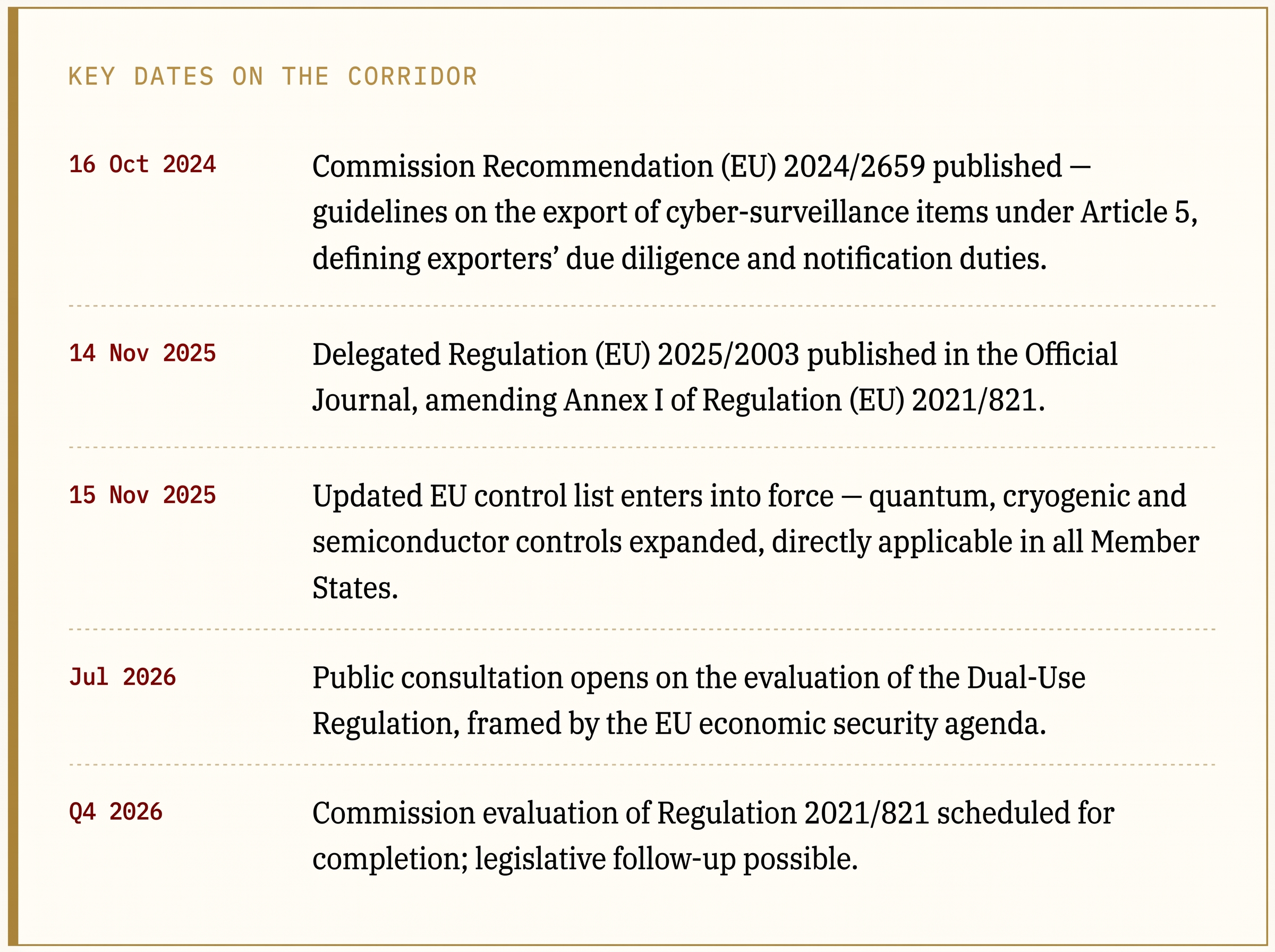
The catch-alls are no longer left to exporters’ intuition. With Commission Recommendation (EU) 2024/2659 of 11 October 2024, published in the Official Journal on 16 October 2024, the Commission issued formal guidelines on the export of cyber-surveillance items under Article 5 — the first structured articulation of what the due diligence obligation actually requires. The guidelines clarify the definition of non-listed cyber-surveillance items, describe transaction-screening and risk-assessment steps, and set out when an exporter must notify its competent authority. Issued under the “protect” pillar of the EU’s Economic Security Strategy, they convert Article 5 from an abstract human-rights safeguard into an operational compliance workstream. The Türkiye relevance is direct: Turkish purchasers of network monitoring equipment, lawful-interception systems, biometric platforms and data analytics tools should expect their EU suppliers to request end-use representations addressing surveillance risk specifically — and Turkish suppliers selling comparable technology onward should understand that their EU-origin components may carry these expectations downstream. This is not theoretical volume either: in 2024, Member States received 320 applications for the export of cyber-surveillance items — 233 of them for telecommunications interception systems — issuing 293 authorisations against 13 denials, and Türkiye features among the destinations of those applications.
The November 2025 List Update and the 2026 Evaluation
The EU updated Annex I through Commission Delegated Regulation (EU) 2025/2003, published in the Official Journal on 14 November 2025 and in force from 15 November 2025. The update transposes decisions taken in the multilateral regimes during 2024 and is the most technologically consequential revision in several cycles. New and amended entries concentrate on quantum technology — quantum computers, electronic components engineered for cryogenic operating temperatures, parametric signal amplifiers, cryogenic cooling systems — alongside additional semiconductor manufacturing controls and refinements across established categories. Companies on either side of the corridor whose products sat comfortably outside the control list in 2024 should re-run their classification: the perimeter has moved, and it has moved in precisely the sectors where Turkish industry is investing most aggressively.
The list is not the only thing in motion. The Commission has opened a formal evaluation of Regulation 2021/821 itself, launched with a public consultation in July 2026 and scheduled for completion in the fourth quarter of 2026 under the Commission Work Programme. The evaluation follows the December 2025 Joint Communication on strengthening European economic security and will assess whether the Regulation remains fit for a geopolitical environment the 2021 recast did not fully anticipate — including whether the EU should be able to control items blocked in the multilateral regimes by the veto of individual participating states, an option the Commission first floated in its January 2024 White Paper on export controls. Read together with the third-country anti-circumvention emphasis of recent EU sanctions packages, the direction of travel is unambiguous: more items controlled, more scrutiny of where they end up, and more expectation that non-EU counterparties — Turkish counterparties prominently among them — can evidence legitimate end-use.
Licences, Certificates and the Turkish Side of the Transaction
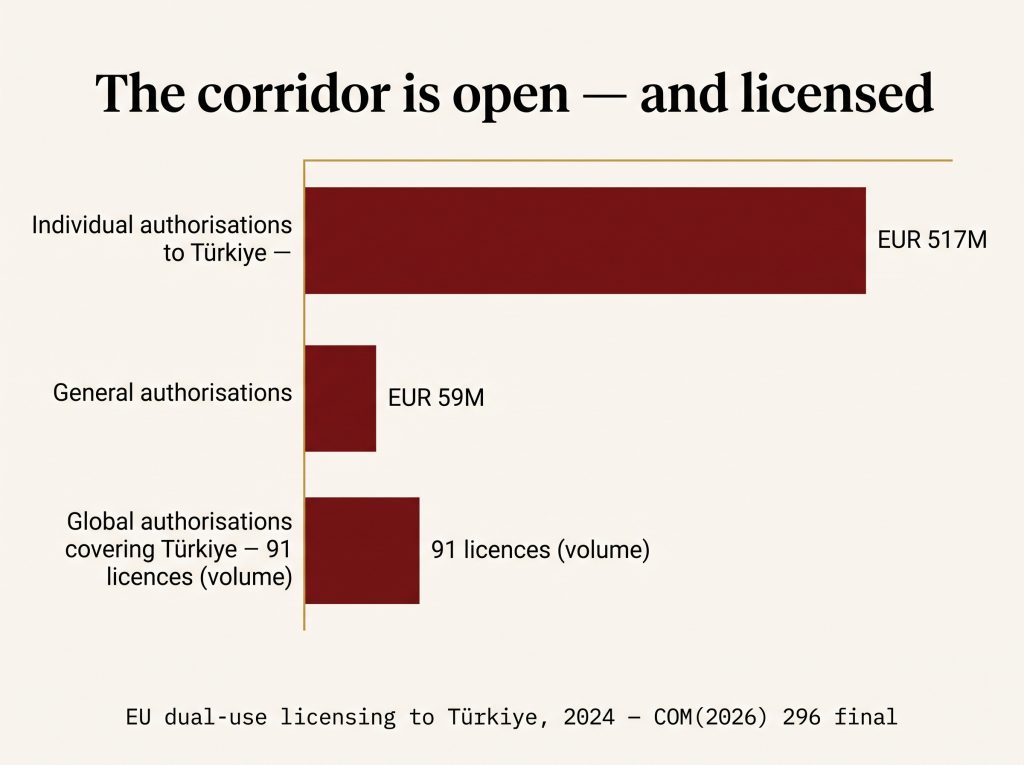
For an EU exporter, authorisation for a Türkiye-bound shipment of Annex I items takes one of three principal forms, issued by the national competent authority of the Member State where the exporter is established. An individual export authorisation covers one exporter, one end-user, specified items. A global export authorisation covers a type or category of items to specified end-users or destinations — the workhorse for companies with recurring Turkish trade, and one for which the exporter must submit an internal compliance programme merely to qualify. The Union General Export Authorisations (EU001 through EU008), which permit certain exports on registration alone, are of limited assistance here: Türkiye is not among the low-risk destinations covered by EU001, so the general authorisations apply only in narrow scenarios such as temporary export for exhibitions or specific item baskets. In practice, the Turkish market runs on individual and global licences — which means it runs on the quality of the end-use documentation the Turkish counterparty can produce. Nor is this an exotic corner of EU trade administration. The Commission’s annual implementation report, COM(2026) 296 final, adopted on 25 June 2026 and covering the 2024 reference year, puts total authorised EU dual-use trade at EUR 77.6 billion — 3% of all extra-EU goods exports — across 133,470 authorisations and notifications. Among individual authorisations, the largest values were granted for nuclear materials, facilities and equipment (EUR 12.2 billion), telecommunications and information security (EUR 6.7 billion) and aerospace and propulsion (EUR 4.6 billion) — the very sectors in which Turkish industrial demand is concentrated. And Türkiye is squarely on the map: the report records EUR 517 million in individual export authorisations to Türkiye, placing it among the top extra-EU destinations, alongside 91 global export authorisations covering Türkiye and a further EUR 59 million authorised under general authorisations. Set against those volumes, Member States reported only 487 denials worth EUR 0.2 billion for the entire year — 0.01% of extra-EU goods exports. The statistical lesson is one we make a point of putting to hesitant boards: the licensing system approves the overwhelming majority of well-documented applications. Denial is the exception; preparation determines which side of that statistic a transaction lands on.
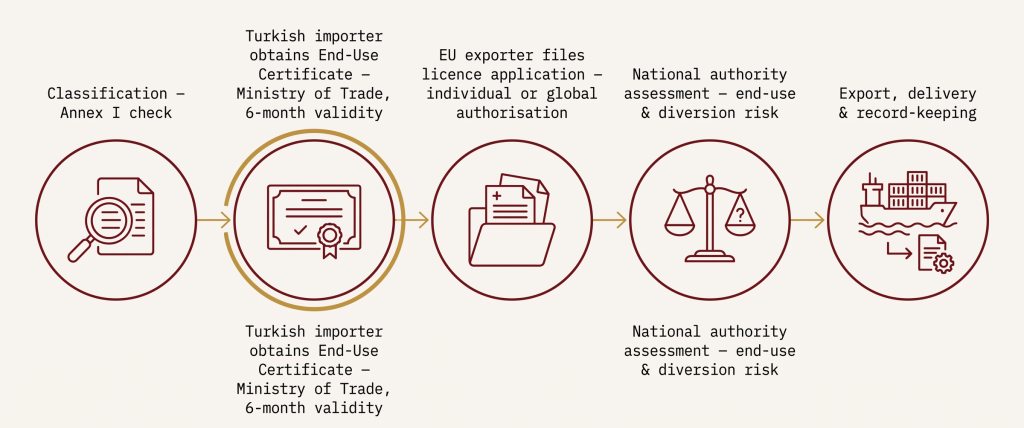
This is where Türkiye’s own framework becomes a commercial instrument rather than a formality. Türkiye participates in all four multilateral export control regimes and mirrors their lists through national legislation, with licensing competence distributed across the Ministry of National Defence (military items under Law No. 5201), the Ministry of Trade (dual-use items), and the nuclear authorities (NSG-listed materials). For inbound transactions — the posture most relevant to EU exporters — Turkish law provides two certificates that foreign licensing authorities routinely require. The İthal Şehadetnamesi (Import Certificate) and the Nihai Kullanım Sertifikası (End-Use Certificate) are approved by the Ministry of Trade’s General Directorate of Import upon the Turkish importer’s electronic application. Both are valid for six months and are not subject to extension — a deadline that has quietly killed more transactions than any refusal ever has, because licensing timelines in the exporting state frequently outrun a certificate obtained too early. Where the end-user differs from the importer, both must be named on the certificate and both are jointly responsible for the undertakings it contains. Chief among those undertakings: the goods will not be re-exported to a third country without the express permission of the Ministry of Trade, with a corresponding permit letter routed back through the General Directorate of Import if a transfer is later contemplated. Breach is not an administrative footnote — Anti-Smuggling Law No. 5607 attaches imprisonment and substantial judicial fines to the export of prohibited goods, and diversion in breach of an end-use undertaking places the Turkish company squarely in the enforcement sightlines of both Ankara and the original exporting state.
Reading the Regime Commercially
Our consistent advice to clients on both sides of the corridor is to treat this architecture as a qualification round. EU national authorities assessing a Türkiye-destined licence application are weighing diversion risk — a concern amplified by the sustained Western attention on re-export flows toward Russia and by the explicit third-country focus of recent EU sanctions packages — and enforcement is visibly hardening: reported infringements across the Union rose from 192 in 2023 to 270 in 2024, with penalties imposed climbing from 122 to 144 over the same period. An application supported by a Ministry-approved end-use certificate, a coherent corporate profile of the Turkish end-user, and evidence of an internal compliance programme structured along the lines of Commission Recommendation (EU) 2019/1318 — the framework EU licensing authorities actually benchmark against, covering management commitment, transaction screening, performance review and record-keeping — is a materially different application from one supported by a pro-forma invoice and hope. The same discipline now reaches into contracts: Turkish importers routinely encounter contractual “no re-export to Russia” undertakings that EU suppliers are required to impose on third-country buyers of sensitive goods, and a counterparty that accepts, operationalises and can evidence compliance with such clauses signals reliability in the strongest currency the licensing process recognises. Turkish importers who can assemble that file on demand — certificate timing synchronised with the exporter’s licensing calendar, end-user undertakings understood at board level, re-export controls embedded in contracts — consistently obtain licences that their competitors are denied or that arrive too late to matter. For EU exporters, the same logic runs in reverse: counterparty due diligence on Turkish customers, screened against EU, UK and US restricted party lists and documented to the standard national authorities now expect, is what converts the Turkish market from a compliance question into a revenue line.
The expanded November 2025 controls make this a moment of opportunity rather than retrenchment. Turkish industry’s procurement of quantum-adjacent components, cryogenic systems and semiconductor tooling will increasingly pass through the licensing gate — and companies that build the documentary infrastructure now will be the ones through which that trade flows. With the Commission’s evaluation of the Dual-Use Regulation concluding in late 2026 and further tightening plausible, the corridor will not get simpler. It will, however, keep rewarding the prepared. HERDEM advises EU exporters, Turkish importers and end-users, and financial institutions on classification, licensing strategy, end-use certification and internal compliance programmes across the full breadth of the EU, UK, US and Turkish control regimes.
This guidance note is provided for general information only and does not constitute legal advice. Specific transactions require specific analysis.