
 EN-US
EN-US  TR-TR
TR-TR 
The Sanctioning Russia Act is no longer a talking point. It is a bill with a Senate–White House agreement behind it, a bipartisan supermajority of cosponsors, and a tariff mechanism built to survive the Supreme Court. Türkiye sits inside its target radius alongside China and India — and the companies that move first will write the terms on which they compete.
Senator Lindsey Graham (R-SC), the bill’s lead architect, died unexpectedly on the evening of 11 July 2026, hours after announcing the White House agreement described below. His death has since become the catalyst for a faster path to the floor: Senators Blumenthal, Shaheen, and Wicker, joined publicly by Majority Leader Thune and Minority Leader Schumer, are calling for the Senate to pass the bill this week as a tribute to his work. With 85 cosponsors, a vote — if scheduled — would likely pass overwhelmingly.
Separately, reporting on the negotiated text indicates the updated version narrows the scope of the original secondary tariff mechanism described below. What that means for the countries and purchase categories actually covered — and for Türkiye’s exposure specifically — cannot be confirmed until the revised text is published. Treat the exposure analysis that follows as the baseline case; we will issue a follow-up the moment the text is public.
On 10–11 July 2026, Senators Lindsey Graham (R-SC), Richard Blumenthal (D-CT), Jeanne Shaheen (D-NH), and Roger Wicker (R-MS) announced that they had reached agreement with the White House on an updated version of S.1241, the Sanctioning Russia Act of 2025. After more than a year of stalled timelines, the bill — then carried by 84 Senate cosponsors (now 85), a majority sufficient to override a presidential veto — moved, for the first time, onto a real path toward a floor vote. As detailed in the update above, events since then have accelerated that path further while leaving the bill’s precise scope still unconfirmed.
For Turkish energy traders, refiners, and the banks that finance them, the relevant question is not whether the bill passes in exactly its current form. It is what a company’s sourcing, banking, and documentation posture looks like on the day a presidential determination is made — because under the bill’s mechanics, that posture is decided well before the determination itself.
What the Bill Would Authorize
S.1241 is built around a “covered determination” — a presidential finding that Russia is refusing to negotiate peace, violating an agreement, or renewing aggression against Ukraine. Once triggered, the bill removes discretion from the executive on a defined menu of measures:

The Legal Architecture Behind the Tariff
The tariff mechanism is not incidental to the bill’s design — it is the reason the bill exists in its current form. On 20 February 2026, the Supreme Court ruled 6-3 in Learning Resources, Inc. v. Trump that the International Emergency Economic Powers Act does not authorize presidential tariffs, since IEEPA’s power to “regulate” imports does not amount to the clear congressional delegation the Constitution requires for a core taxing power. S.1241 answers that ruling directly: its tariff authority derives from its own statutory text, not from IEEPA, which is precisely why sponsors describe it as more durable than the tariff orders it would effectively supersede. For counsel advising on exposure, this matters — a S.1241 determination is far harder to challenge on the same constitutional grounds that unwound the 2025 tariff regime.
The Turkey Exposure Profile
Türkiye is not a peripheral case in this legislation. It is one of three countries — alongside China and India — that the bill’s own drafters and independent tracking organizations identify as the principal targets of the secondary sanctions and tariff provisions, because these three jurisdictions absorb the overwhelming majority of Russia’s seaborne energy exports.
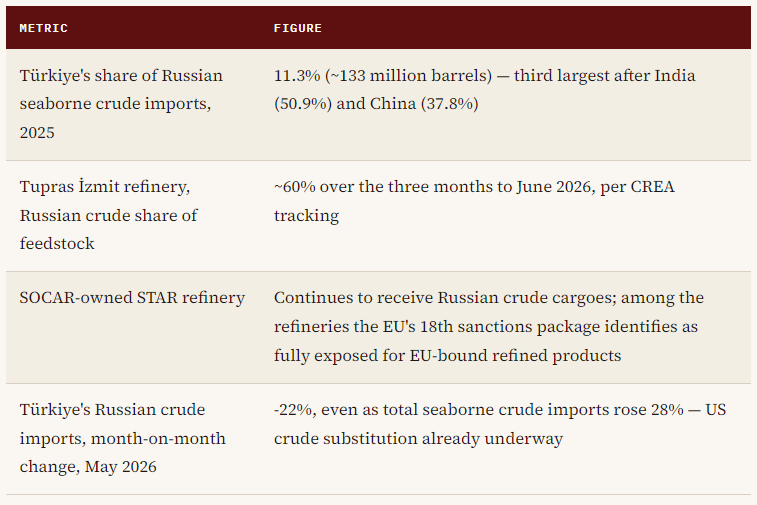
The direction of travel is already visible. Tupras has been increasing purchases of non-Russian, Urals-comparable grades — particularly Iraqi blends — since Washington’s October 2025 blocking sanctions on Rosneft and Lukoil under Executive Order 14024. That adjustment was driven by EU compliance pressure. S.1241 would layer a second, independent US trigger on top of it — one tied not to ownership of a specific Russian producer, but to the simple fact of purchase.
“With Turkey, they are still importing Russian barrels, but it is going down as we speak — their volumes are down 20-30 percent.” — Kpler analyst commentary, January 2026
Where the Opportunity Sits
The instinct in a sanctions story is to read it purely as a risk to manage. That undersells what is actually available here. A presidential determination under S.1241 is not a switch that flips uniformly across every purchaser — it is a designation applied to specific countries, on a 90-day renewable cycle, with a 180-day national security waiver built into the statute. That structure creates real differentiation between companies that arrive at the determination date with clean, documented, diversified sourcing and banking arrangements, and those that do not.
- First-mover sourcing advantage. Refiners that complete the shift away from Russian feedstock ahead of a determination — as Tupras’ İzmir plant did in relation to EU rules — are positioned to keep US and EU market access uninterrupted while slower-moving competitors face a 500%-equivalent tariff wall.
- Waiver-readiness as a competitive asset. The bill’s 180-day waiver is discretionary and security-based. Companies that can demonstrate a credible, documented transition plan before any determination are the ones a waiver process is built to favour.
- Banking relationship continuity. Turkish financial institutions that pre-emptively map and unwind exposure to the named Russian institutions avoid being caught inside a correspondent-banking freeze that a slower peer institution might not.
- Market share redistribution. If China and India face steeper adjustment costs than Türkiye — whose refiners started diversifying earlier under EU pressure — Turkish traders and refiners are better placed to capture displaced EU and US demand for compliant refined products.
What We’re Watching
The updated bill text, still not public as of 14 July 2026; confirmation of how far the negotiated version narrows the original 500% tariff mechanism and which purchasing countries and categories it retains; the scope and conditions attached to the presidential waiver authority; and whether Senate leadership schedules a floor vote this week, as several senators have now urged. HERDEM will issue a follow-up the moment the revised text is released.
The Compliance Layer, Briefly
None of the above removes the underlying obligation to get the documentation right: sourcing certificates that withstand scrutiny, correspondent bank due diligence on Russian-linked counterparties, and internal determination-monitoring protocols tied to the bill’s 15-day and 90-day triggers. The companies best placed to benefit from the opportunities above are, not coincidentally, the ones whose compliance architecture was already built to this standard.