
 EN-US
EN-US  TR-TR
TR-TR 
Türkiye’s defence industry no longer merely absorbs industrial participation obligations — it writes them. For international primes, investors, and governments, the question is no longer whether to engage the Turkish market, but how to structure the entry.
Three signals arrived within a single month. In June 2026, Washington formally notified Congress of a proposed export of General Electric F110 engines for the KAAN Block 10 fighter — a package reported at USD 705 million, and the clearest indication yet that the aircraft’s first export configuration is politically and legally executable. Days earlier, over Italian test ranges, Baykar’s Kızılelma completed the first phase of live crewed–uncrewed teaming trials under the Leonardo–Baykar K-SWARM programme, autonomously flying formation with a Leonardo M-346 — proof that the joint-venture model between a Turkish unmanned systems champion and a European prime works not only on paper but in the air. And on 29 June, days before NATO leaders convened in Ankara, Türkiye’s President publicly demanded the country’s inclusion in all European defence and security initiatives, with access to the European Union’s EUR 150 billion Security Action for Europe (SAFE) instrument squarely at issue.
Each signal, read alone, is a procurement headline. Read together, they describe a structural repositioning. Türkiye has become the rare mid-tier producer that sits on both sides of the offset table simultaneously: an acquiring state imposing industrial participation obligations on foreign suppliers under one of the world’s more demanding offset regimes, and an exporting state granting technology transfer, co-production, and localization commitments to customers from Jakarta to Riyadh. For international defence companies, that dual position is precisely what makes the market compelling — and legally intricate.
A Record Cycle, Compounding
The numbers behind the repositioning are no longer aspirational. Turkish defence and aerospace exports surpassed USD 10 billion in 2025, with USD 17.9 billion in new export contracts signed across the year — a volume the Presidency of Defence Industries (SSB) has described as a golden age, distributed across Asia-Pacific (USD 5.5 billion), Europe (USD 5.3 billion), the Americas (USD 3.3 billion), the Middle East (USD 2.2 billion), and Africa (USD 1.7 billion). The composition matters as much as the volume: rockets, missiles, and smart munitions accounted for USD 3.7 billion, unmanned aerial vehicles for USD 2.1 billion, and platform-level exports — fighter aircraft, jet trainers, frigates, logistics vessels — entered the ledger for the first time at scale.
The momentum has compounded into 2026. Sector exports exceeded USD 2.8 billion in the first four months of the year, a 28 percent increase, while Turkish companies signed close to USD 8 billion in export agreements during the opening days of the SAHA 2026 exhibition in Istanbul alone. ASELSAN, the sector’s electronics flagship, reported first-quarter export contracts up 69 percent year-on-year to USD 629 million against a backlog of USD 20.7 billion — and is investing in serial production capacity at a rate that signals demand it cannot yet fill. The SSB’s stated target of surpassing USD 11 billion in exports for 2026 now reads conservative rather than ambitious.

Both Sides of the Table
What distinguishes Türkiye from other rising exporters is not the export curve itself but the country’s simultaneous posture as a sophisticated acquiring state. The GBP 8 billion (USD 10.7 billion) Eurofighter Typhoon acquisition — twenty new-build Tranche 4 aircraft contracted in October 2025, followed by a multibillion training, logistics, and technical support contract signed in London on 25 March 2026 — is the largest inbound platform procurement in years, and it arrives under an offset architecture that Türkiye has spent a decade sharpening. Under the SSB’s framework, offset commitments on foreign-supplied projects are set at no less than 70 percent of contract value, administered through dedicated offset agreements annexed to the supply contract, with export-type and technological-cooperation-type obligations, coefficient-weighted crediting, and financial guarantees securing performance.
On the outbound side, the same logic now runs in reverse. The KAAN agreement with Indonesia — forty-eight fifth-generation aircraft in a package reported at USD 10 billion — embeds Indonesian local-capability integration and technology transfer across a ten-year delivery horizon. Baykar’s first Kızılelma export, signed with Indonesia’s PT Republik Aero Dirgantara at SAHA 2026, frames an initial batch of twelve unmanned combat aircraft with options rising toward sixty, and includes the establishment of local production and maintenance facilities. Saudi Arabia’s SAMI has partnered with Türkiye’s ULAQ to co-develop unmanned surface vessels inside the Kingdom, following the localization template Baykar established there in 2023. Ankara has now concluded bilateral defence industry cooperation agreements with close to one hundred governments — frameworks that typically contemplate joint development, co-production, technology transfer, and consent-based third-country export, effectively converting each bilateral relationship into a platform for downstream industrial commitments.
Türkiye is no longer a jurisdiction where offsets happen to a foreign supplier. It is a jurisdiction that exports its own offset doctrine.
For the first time, Turkish primes are learning the obligor’s side of the ledger — managing offset fulfilment risk, credit valuation, milestone certification, and local-content verification in foreign jurisdictions whose offset authorities are as demanding as the SSB itself. This is a consequential shift: the contract-management disciplines, guarantee structures, and dispute-resolution architecture that foreign suppliers have long had to master in Ankara are now equally material to Turkish companies in Jakarta, Riyadh, and Warsaw — and to the international partners who joint-venture with them.

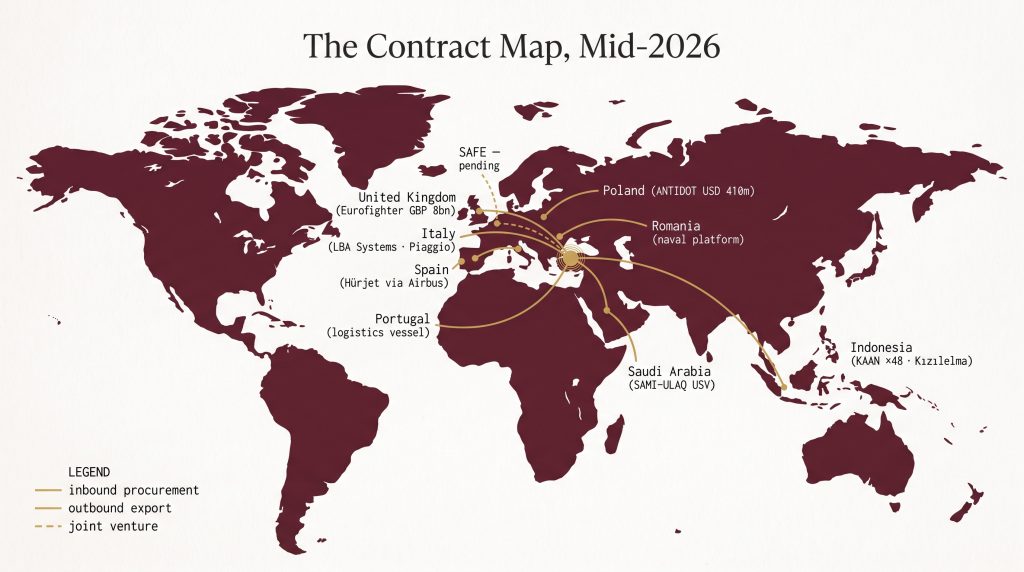
The Contract Map, Mid-2026
The live contract landscape is unusually dense for a single market. In combat air, the Eurofighter programme anchors the inbound column: final assembly of Türkiye’s Tranche 4 aircraft is underway at BAE Systems’ Warton facility, with first deliveries scheduled for 2030, UK-based training for Turkish instructor pilots and nearly one hundred maintenance trainers already contracted, and parallel negotiations continuing for up to twenty-four Tranche 3A aircraft from Qatar and Oman to compress the capability timeline — transfers that will each require third-party consent from the four consortium governments and their export-control authorities. The comprehensive weapons package, reported to include MBDA Meteor and Brimstone munitions, adds a further layer of European licensing dependencies, while Ankara’s stated intent to certify indigenous Turkish munitions onto the Typhoon opens a reciprocal integration workstream with its own intellectual property and airworthiness dimensions.
In unmanned systems, the Leonardo–Baykar joint venture, LBA Systems, has moved from signature to demonstrated capability inside eighteen months — the June 2026 K-SWARM trials being the visible milestone — while Baykar’s acquisition of Piaggio Aerospace gives a Turkish champion a certified European manufacturing and MRO footprint. In trainers, an April 2026 agreement between Airbus and Turkish Aerospace structures Hürjet exports to Spain, their customization to Spanish standards, and their integration into a combat training system — a Turkish platform entering a Eurofighter consortium nation’s inventory through a European prime. In electronics, ASELSAN’s USD 410 million contract to supply ANTIDOT electronic attack and support pods for Poland’s Bayraktar TB2 fleet through 2035 sits alongside a three-year NATO Support and Procurement Agency framework for identification-friend-or-foe systems. In naval platforms, STM is building a logistics support vessel for Portugal, TAIS is delivering frigates to Indonesia, and ASFAT has sold a naval platform to Romania — three European and Asia-Pacific navies procuring Turkish hulls concurrently.
Two structural developments will shape the next wave. First, the SSB has operationalized a government-to-government military sales model from 2026, completing the legislative framework in 2025 — a Turkish analogue to the American FMS channel that will let Ankara offer everything from company-level commercial contracts to full state-to-state packages, with the sovereign guarantee and financing implications that model carries. Second, the SAFE question: Türkiye is technically eligible to participate in the EU’s EUR 150 billion joint-procurement instrument, project proposals under which run until 30 June 2027 with full disbursement expected by the end of 2030. Participation requires a bilateral agreement with the EU under Article 17 of the SAFE Regulation — a decision entangled with member-state politics, but one on which Germany, Italy, Spain, and Poland have signalled openness, and which the July NATO summit in Ankara has pushed to the top of the continental agenda.
The Forward Curve
Four developments are worth positioning for now, rather than after they crystallize. The KAAN serial production contract is expected within 2026 — the Turkish Air Force has already ordered its first batch of twenty Block 10 aircraft — and each incremental order deepens the supplier qualification pipeline into which foreign subsystem providers can sell. A second export customer is the logical next headline: Saudi Arabia’s flag has already appeared on a KAAN display model, and interest attributed to the UAE, Spain, and others suggests the Indonesian structure — platform sale wrapped in technology transfer and local industrial participation — will be replicated, not improvised. Every such deal generates a bundle of negotiable positions: workshare allocation, IP licensing, export-control flow-downs on the American engine, and offset obligations owed by Turkish primes to the customer state.
The SAFE trajectory is the second curve. Whatever the pace of the political track, the commercial logic is already operating: European governments drawing SAFE loans must direct them toward eligible supply chains, and Turkish industry is positioning to qualify through joint ventures, European subsidiaries, and consortium participation even before a bilateral agreement lands. The Baykar–Piaggio and LBA Systems structures are instructive precisely because they create European-domiciled entities with Turkish technology inside them — a corporate answer to a treaty question. Expect more of these: acquisitions of European certified manufacturers, dual-jurisdiction JVs, and licensing structures designed so that eligibility debates in Brussels do not gate commercial access.
Third, the Gulf transfer track. The prospective purchase of Tranche 3A Typhoons from Qatar and Oman is, legally, among the more intricate transactions in the pipeline: used-aircraft transfers require consortium consent, government-to-government assurances, munitions re-export approvals, and the disentangling of the sellers’ own offset and support obligations. Fourth, the outbound delivery wave itself: Kızılelma first deliveries, TB3 naval UAV handovers, and the maturing of co-production facilities in Indonesia and Saudi Arabia will convert signed frameworks into operating industrial plants — the phase in which offset fulfilment, local-content certification, and milestone disputes actually materialize.
The Legal Architecture Beneath the Headlines
Every transaction described above runs across a legal substrate that rewards early structuring and punishes improvisation. Inbound, the governing text is the SSB’s 2022 Industrialization Guideline, which broadened the 2011 offset regime into a comprehensive industrial participation framework covering both foreign and domestic contractors. Foreign suppliers sign an Offset Agreement annexed to the supply contract; domestic primes assume an Industrialization Liability combining Local Content and Technology and Product Acquisition (TÜK) obligations, secured by a guarantee equal to six percent of the total liability. Local content itself decomposes into Turkish Added Value (YİKD), sub-industry/SME workshare, and EYDEP-assessed workshare components — each separately measured, each capable of independent default. The guideline is not legislation, but through incorporation into every SSB contract it has de facto normative force, and its crediting coefficients, product-library mechanics, and milestone certifications are where value is won or lost in negotiation.
Layered above the Turkish framework sit the export-control regimes of Türkiye’s partners. The KAAN’s export configuration currently flies on the General Electric F110 — meaning every KAAN export campaign carries US retransfer consent, congressional notification, and end-use assurance dependencies until the indigenous TF35000 engine matures in the 2030s. The Eurofighter package imports four-nation consortium consent requirements and UK licensing on the munitions suite; the Qatari and Omani transfers add third-party transfer approvals; and indigenous munitions certification onto the Typhoon raises IP-allocation and airworthiness questions that the consortium has rarely confronted from a customer that is also a competitor. Joint ventures such as LBA Systems concentrate a further set of issues: background and foreground IP division in fifty-fifty structures, dual export-control compliance (Italian and Turkish), security-cleared personnel regimes, and third-country marketing consent when the JV’s products compete with either parent’s national programmes.
Foreign direct investment into the Turkish defence base is itself a regulated act: SSB approval governs defence-sector FDI, facility security clearances under Law No. 5202 condition participation, and quality-assurance validation gates export licences and offset milestone approvals. Outbound, Turkish primes and their international partners face the mirror image — offset authorities in Indonesia, Saudi Arabia, and the Gulf with their own multipliers, local-content audits, and penalty regimes, frequently in jurisdictions where offset enforcement practice is opaque and dispute-resolution clauses carry unusual weight. Across the whole map, the recurring failure points are familiar to any practitioner: offset credit valuation disagreements, liquidated damages on missed industrialization milestones, guarantee calls, retransfer consent delays that cascade into delivery default, and JV deadlock provisions drafted for peacetime that meet wartime demand curves.
The opportunity is real, the demand curve is steep, and the legal substrate is navigable — provided it is engaged as architecture, not afterthought.
This is the terrain on which HERDEM Attorneys at Law has built its defence and aerospace practice. The firm advises foreign primes, subsystem suppliers, and investors on SSB offset and industrialization negotiations, defence FDI approvals and security clearances, JV and co-production structuring, export-control interfaces across US, UK, and EU regimes, and the drafting and dispute management of offset agreements on both the inbound and outbound sides of the Turkish market. Having analyzed the evolution from the 2011 to the 2022 offset guidelines at close range, the practice approaches industrial participation not as a compliance tax but as the commercial core of the transaction — the place where a bid is actually won.
Why the Entry Point Is Now
For international players weighing the Turkish market, the attraction rests on convergence. First, scale with trajectory: a ten-billion-dollar exporter targeting eleven, with a twenty-billion-dollar order backlog at its flagship electronics house and platform programmes — fifth-generation air, naval, unmanned — that will demand qualified foreign subsystems for a decade. Second, NATO interoperability at a structural cost advantage, in a sector where European rearmament budgets are chasing constrained capacity. Third, proven partnership templates: the Leonardo joint venture, the Airbus–TAI trainer arrangement, and the Piaggio acquisition demonstrate that European primes can structure durable, IP-protected collaboration with Turkish champions — and that such structures can double as SAFE-eligibility vehicles. Fourth, a maturing institutional interface: the new G2G sales channel, an offset regime that is demanding but codified and predictable, and a talent base that in 2025 recorded net inbound migration of qualified defence engineers for the first time.
And there is the timing asymmetry. The bilateral politics of SAFE, the sequencing of KAAN export campaigns, and the Gulf Typhoon transfers will resolve over the next eighteen to thirty-six months. The companies that will benefit are those already inside the qualification pipelines, joint-venture structures, and offset frameworks when they do. In defence industrial strategy, as in the offset agreements that govern it, the credits accrue to those who invested before the milestone — not after.