
 EN-US
 TR-TR
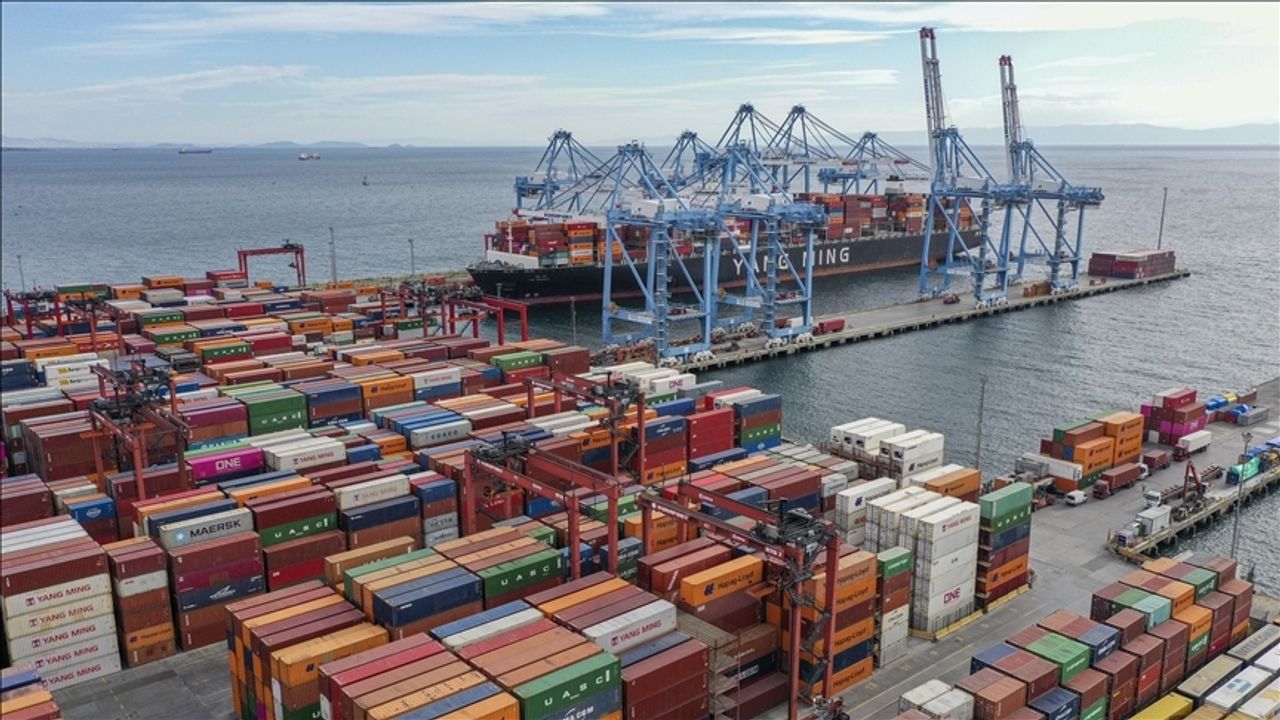
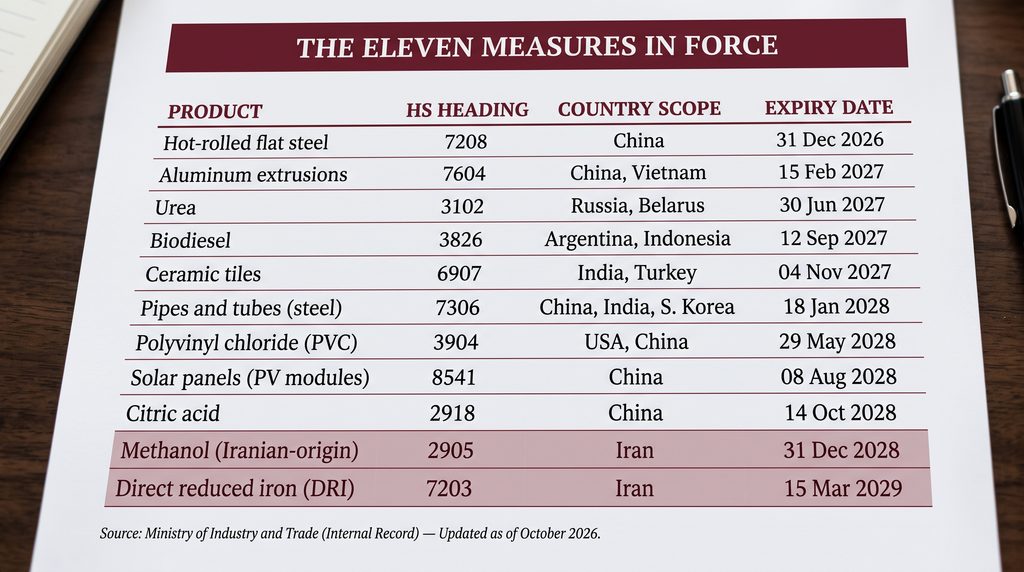
Türkiye has eleven safeguard measures in force. Most exporters model them as a three year cost at a fixed rate. The Ministry of Trade’s own published record shows that neither assumption holds, and that the only published relief is allocated on a basis no American, European or British exporter can meet.
A safeguard measure usually reaches a company through its accounts rather than its legal department. The Turkish importer reports a charge on clearance, the supply chain team confirms the figure, and it becomes a cost to absorb or pass on. By the time anyone asks how long it will last and whether it could have been contested, the proceeding that produced it has closed.
That is avoidable. The proceeding runs for months in public, and the Ministry of Trade publishes a consolidated record of everything in force. This article works from that record as updated on 30 July 2026, and identifies the two assumptions that most often prove wrong when an exporter in the United States, the European Union or the United Kingdom plans around a Turkish safeguard.
What a safeguard measure in Türkiye is, and what it is not
Turkish safeguards operate under the Decision on Safeguard Measures for Imports, decree 2004/7305, published in the Resmî Gazete of 29 May 2004, issue 25476. Investigations are run by the Ministry of Trade through its General Directorate of Imports, and decisions on initiation and on provisional and definitive measures are taken through the Safeguard Evaluation Board constituted under Article 4.
Article 6 sets out the forms a measure may take: an increase in customs duty, an additional financial obligation, a quantity or value restriction, a tariff quota, or a combination. In practice the dominant form is the additional financial obligation, charged per tonne, per kilogram or per unit, or as an ad valorem percentage. Article 5 permits a provisional measure where delay would cause damage difficult to repair.
This is worth separating from the regime it is most often confused with. A safeguard responds to a surge in imports and injury to the domestic industry, irrespective of how any exporter priced its goods. An anti-dumping proceeding responds to the pricing conduct of identified exporters. An exporter who reads a safeguard notice as an allegation about its own pricing prepares the wrong file. A safeguard is not an accusation. It is a market wide measure in which an exporter may have no individual fault and still carry the full charge.
The eleven measures in force and the sectors they reach
As at 30 July 2026 the Ministry records eleven safeguard measures in force, covering float glass, polyester staple fibre, toothbrushes, yarns of nylon and other polyamides, PET chips, grinding balls, wire rod products, paper of the fluting and testliner type, ethyl acetate and PET resin.
The sectoral spread matters more than the list length. These are industrial chemicals, packaging resins, paper and board, steel long products and abrasive media: the goods that mid-sized American, German, Italian, Spanish and British producers ship into Türkiye in volume, often through a distributor who absorbs the customs interface and reports upward only when a figure changes.
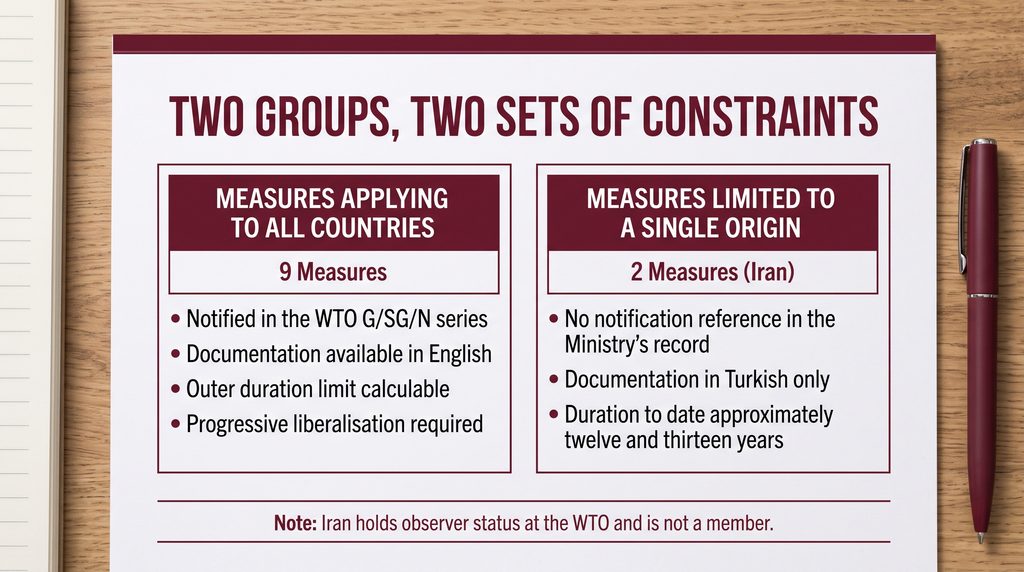
Nine of the eleven apply to imports from all countries. Two are limited to goods of Iranian origin, and that distinction carries more weight than it appears to.
Why a three year measure is usually a nine year measure
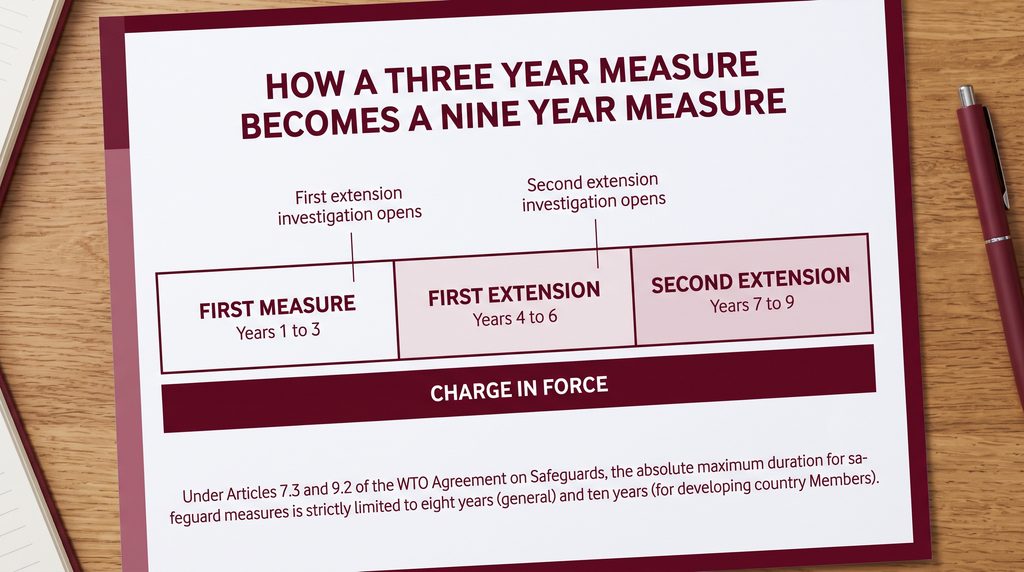
A Turkish safeguard is normally announced for three years, and that is the figure that reaches the commercial team. It accurately describes the current decree and misdescribes the exposure.
Under the World Trade Organization Agreement on Safeguards, a measure may run for an initial period of up to four years under Article 7.1, and the total period including any provisional measure, the initial application and any extension may not exceed eight years under Article 7.3. Article 9.2 allows a developing country Member applying a measure to extend it by up to two further years, bringing the outer limit to ten.
Against that ceiling the Turkish pattern is consistent. Seven of the eleven measures in force are already running on at least one extension. The toothbrush measure began on 3 February 2018 and now runs to 2 February 2027 on its second extension. The measure on yarns of nylon and other polyamides began on 21 November 2019 and runs to 20 November 2028, also on a second extension. Each has run in successive three year blocks. Each is now a nine year measure.
The mechanism is visible in the publication dates. An extension investigation opens well before the existing measure expires, and the replacement takes effect on the day the old one ends. The toothbrush extension was initiated on 16 July 2023, concluded on 3 February 2024, and took effect from 3 February 2024. The grinding ball extension was initiated on 4 March 2025, concluded on 7 August 2025, and its rates run from 26 August 2025. In neither case was there a day on which the product entered Türkiye free of the charge.
An expiry date in a Turkish safeguard decree is therefore not a date on which the charge disappears. It is a date by which a decision has already been taken, in a proceeding opened six to twelve months earlier, about whether the charge continues. Of the measures currently in force, every one that has reached the end of a term has been extended rather than allowed to lapse.
The rate does not hold, and it does not always fall
The second assumption concerns the figure itself. Turkish safeguard decrees set out a schedule rather than a single rate, and the schedule normally steps down. This is not discretion exercised in the exporter’s favour. Article 7.4 of the Agreement on Safeguards requires a measure applied for more than one year to be progressively liberalised at regular intervals, and a measure exceeding three years to be reviewed at its midpoint.
The record shows that requirement applied in small increments. Float glass runs at 36 United States dollars per tonne, then 35, then 34, across its annual periods to December 2027. Toothbrushes run at 0.13 dollars per unit, then 0.11, then 0.09. Polyester staple fibre of Iranian origin runs at 17 per cent, then 16.5, then 16. Ethyl acetate runs at 110 dollars per tonne, then 104, then 99. An exporter modelling exposure on the headline first year figure overstates the later years, and one working from an average understates the opening year. Across a three year contract priced at a fixed landed cost, both errors are material.
A more consequential variant appears in the most recent measure on the list. The PET resin measure opened with a provisional charge of 100 dollars per tonne from 31 December 2025 to 18 July 2026. The definitive measure that replaced it runs at 120 dollars per tonne from 19 July 2026, then 115, then 110 to the end of 2028. The definitive first year rate is twenty per cent above the provisional rate that preceded it.
That is consistent with the framework, because progressive liberalisation applies to the definitive measure across its own period and the provisional measure is a separate instrument. It is also the most expensive misreading available here. A provisional charge is the first figure an exporter sees and the natural anchor for a revised price list. It is not a forecast of the definitive charge.
Not every measure resolves to a single number. The measure on yarns of nylon and other polyamides runs from 0.0475 to 0.24 dollars per kilogram in its first annual period, with the applicable figure depending on the subheading. For a producer shipping several grades under one commercial description, that is not one charge but several, and the classification of each grade decides which applies.
COMPANY A
Company A is a European producer of packaging resins supplying a Turkish converter under a three year contract at a fixed delivered price. A provisional safeguard charge appears on the first clearance after the investigation opens. The amount is modest against the contract value, so the converter absorbs it and the parties agree to revisit pricing at the next annual review.
By that review the investigation has concluded and the definitive measure is in force at a figure materially above the provisional charge the parties used as their reference. The revised price the converter will accept was calculated from the provisional figure. The charge the producer now faces was set by the definitive decree.
Nothing in the proceeding was irregular and no deadline was missed. The loss comes from treating a provisional measure as an indication of where the definitive measure would land, in a system where the definitive rate is set independently and may be higher.
Origin decides which measure applies
The country scope of a Turkish safeguard is expressed by origin, and origin is a determination of character rather than a record of where a shipment was loaded. Two separate measures sit on the same commodity code for polyester staple fibre. One is limited to goods of Iranian origin, began on 21 September 2013, is on its third extension and is expressed as an ad valorem percentage. The other applies to all origins, began on 24 August 2021, is on its first extension and is expressed as a specific duty per kilogram. A shipment of this product does not face a single measure identifiable from the tariff code. It faces a question of origin that determines which of two measures applies and how the charge is calculated.
For exporters established in the European Union a further step is frequently missed. Goods in free circulation in the Union enter Türkiye under the Customs Union with an A.TR movement certificate, which establishes free circulation status. It does not establish origin, so where a measure is expressed by origin the A.TR does not answer the question the measure asks. The same holds under a preferential arrangement, where the preferential and non-preferential rules can give different answers on one consignment.
The discipline that applies, and the discipline that does not
The division between the nine measures applying to all countries and the two limited to Iranian origin marks the boundary of a body of international discipline, and the Ministry’s record shows where that boundary falls. Article 2.2 of the Agreement on Safeguards provides that safeguard measures shall be applied to a product being imported irrespective of its source. The duration ceilings in Articles 7.3 and 9.2, the liberalisation requirement in Article 7.4 and the notification obligations in Article 12 belong to the same framework. In the Ministry’s record, each of the nine measures applying to all countries carries one or more notification references in the WTO G/SG/N series. Neither of the two measures limited to Iranian origin carries any such reference. Iran holds observer status at the WTO and is not a member.
The consequences are concrete. Where a measure sits inside the notified group, its documentation is available in English through the WTO documents system and its outer limit can be calculated. Where it does not, neither holds, and the two origin specific measures have now run approximately twelve and thirteen years, beyond the ceiling applying to the notified group. The practical point for a reader in the United States, the European Union or the United Kingdom is that a Turkish safeguard applying to all countries can be followed in English, from a public source, from the day the investigation opens.
Developing country quotas, and why they do not reach a US, EU or UK exporter
Every measure on the list is accompanied by a quota allocation published in a separate communiqué, and most of those allocations are expressed as a quantity reserved for developing countries. The toothbrush measure carries an allocation of 6,289,963 units. Wire rods carry 33,898 tonnes, paper 30,624 tonnes, polyester staple fibre of all origins 16,593 tonnes, ethyl acetate 4,644 tonnes and grinding balls 1,040 tonnes, with a provisional 11,079 tonnes on PET resin. Ethyl acetate additionally carries a general quota of 10,000 tonnes.
The basis is Article 9.1 of the Agreement on Safeguards, under which a safeguard shall not be applied against a product originating in a developing country Member while that country’s share of imports does not exceed three per cent, provided that developing country Members below three per cent collectively account for no more than nine per cent of total imports.
The consequence is direct. Relief is allocated by development status, not by trade agreement and not by the existence of a customs union with Türkiye. An exporter established in the United States, in a Member State of the European Union or in the United Kingdom falls outside it and pays from the first tonne. No exemption framed by reference to European Union, United Kingdom or United States origin appears anywhere in the Ministry’s record.
How each allocation operates, and how it interacts with any general quota, is set out in the individual communiqué rather than the measure decree, and differs between measures. That is a document to read for the specific commodity. What generalises is the structural point: where relief exists, it has been directed somewhere other than at the developed economy exporter.
COMPANY B
Company B is an international manufacturer that has shipped one product line into Türkiye for seven years under a safeguard it inherited rather than contested. The charge sits in the landed cost model. The measure carries a published expiry date, and the 2028 commercial plan assumes a return to the unencumbered rate from then.
The expiry date passes and the charge continues. An extension investigation was initiated some months earlier by a communiqué in the Resmî Gazete, the proceeding concluded before expiry, and the extended measure took effect the day the previous one ended. Company B was not notified individually, because it was not a party. It was not a party because it did not respond at initiation, and it did not respond because nobody was reading the Resmî Gazete against its commodity code.
The difficulty is not that the extension was granted. It is that Company B had no position on the record in two successive proceedings about its own product. An extension determination addresses whether the measure remains necessary and whether the domestic industry is adjusting, and those are questions on which an exporter holds evidence no other participant has.
When an exporter’s input actually matters
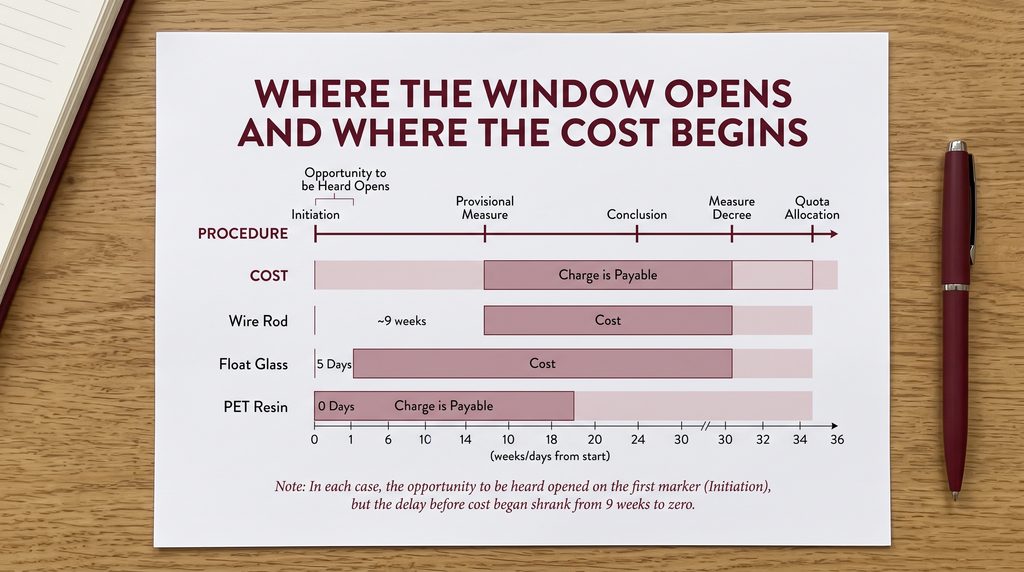
The proceeding follows a visible sequence: initiation, in some cases a provisional measure, conclusion of the investigation, the measure decree, and the quota allocation communiqué. Each step is published. The intervals between them are where the planning question sits, and the Ministry’s publication dates show how short some of them are.
On wire rods, the investigation was initiated on 3 November 2023, the provisional decree was published on 31 December 2023 and the provisional charge applied from 7 January 2024, roughly nine weeks after the proceeding opened. On float glass, the initiation communiqué was published on 7 December 2024 and the provisional decree five days later. On PET resin, the initiation communiqué was published on 31 December 2025 and the provisional charge ran from the same day.
The proceedings themselves have run to different lengths: approximately eight months from initiation to conclusion for wire rods, six and a half for PET resin, and thirteen and a half for ethyl acetate, from the initiation communiqué of 6 April 2024 to the conclusion published on 23 May 2025. Two conclusions follow, pointing in opposite directions. The financial consequence can begin immediately, so an exporter waiting for the outcome before reacting commercially may already be paying. The proceeding runs for the better part of a year, which is ample time to participate for anyone who learns of it when it opens rather than when the invoice changes.
Participation means responding to the initiation communiqué within the period it specifies, supplying the export volume, pricing and capacity data required, and making submissions on the questions in issue: whether imports increased, whether the domestic industry suffered serious injury, whether the two are causally connected, and in an extension whether the measure remains necessary. The exporter holds evidence relevant to each.
HERDEM acts for exporters and importers before the Ministry of Trade on the Turkish side: monitoring initiation communiqués against a client’s commodity codes, filing exporter responses within the published period, making submissions during investigations and extension proceedings, and advising on quota applications and on the origin and classification questions that decide which measure applies. The firm does not act before the European Commission, and an exporter needing representation on both sides should understand that division at the outset.
What an exporter to Türkiye should have in place
Four items distinguish the companies that manage this well, and none is expensive. The first is monitoring at commodity code level rather than product name level. Initiation communiqués are published by tariff heading, and a company monitoring by product description will miss a proceeding on a heading it did not know its goods fell under. The nylon yarn measure, with its range of rates by subheading, shows why the code and not the description is the unit of analysis.
The second is a settled position on origin, documented and capable of being evidenced before any measure arises. Where two measures sit on the same code and differ by origin, the origin file determines the charge, and that file is built while supplier relationships are live.
The third is a decision, taken in advance, on whether the company will participate if an investigation opens on its goods. The answer is not obvious, since participation carries cost and discloses commercial information, and it should be reached deliberately rather than by default while a response period runs.
The fourth is contractual. Supply agreements covering shipments into Türkiye should allocate expressly any additional financial obligation introduced after the contract date, distinguish provisional from definitive charges, and provide for price adjustment on a change in the rate. A safeguard schedule changes the rate at least twice over a three year measure, and more often across an extension.

The question worth asking now
A safeguard measure is usually treated as a tax position: a cost that arrives, is quantified and is passed through. On the Turkish record it behaves differently. It is a proceeding with parties, evidence and a result, in which the exporter paying the charge is often the only interested party absent from the file.
So the question worth putting internally is this. If an investigation opened next month on the commodity code covering the company’s largest shipment into Türkiye, how would the company learn of it, who would decide within the response period whether to participate, and on what evidence? Where those three answers exist, the Turkish system is navigable and in parts favourable, because the proceeding is public, lengthy and evidence based. Where they do not, the company learns of the measure from its own clearance costs, by which point the only question left is who absorbs it.
This article reflects measures in force as recorded by the T.C. Ticaret Bakanlığı, İthalat Genel Müdürlüğü, Korunma Önlemleri Dairesi in its published list of safeguard measures in force updated 30 July 2026, and legislation in force as at October 2026. Company A and Company B are composite illustrations constructed from publicly documented fact patterns and do not describe identifiable persons or matters. This article is provided for general informational purposes and does not constitute legal advice on any specific matter.