
 EN-US
 TR-TR
Microsoft’s ARTEX report shows that a supplier’s credential can open a customer’s data. Under Turkish law the data breach notification stays with the customer, and a draft regulation published on 18 November 2026 would add a 12-hour clock for some companies.
Contents
Key points
- Microsoft’s ARTEX report of 5 November 2026 describes a vendor-owned multitenant credential used to reach multiple customer tenants.
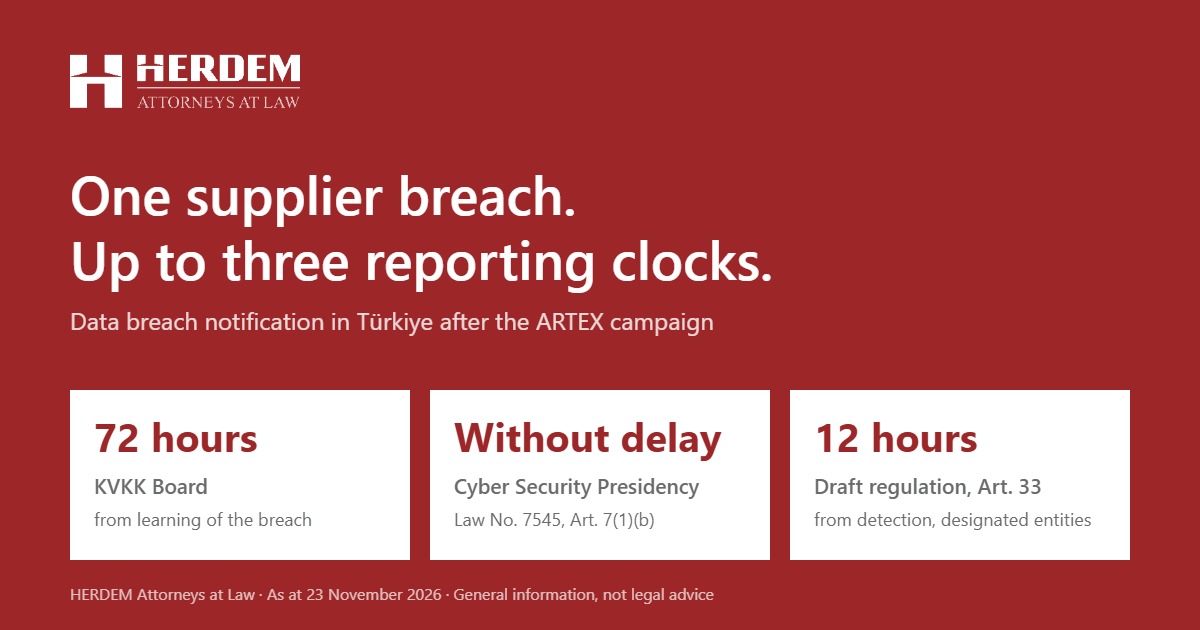
- Under KVKK, data breach notification to the Board is the controller’s duty: without delay and within 72 hours of learning of the breach, under Board decision 2019/10.
- Law No. 7545 adds a separate duty to notify the Cyber Security Presidency of cyber incidents without delay.
- The draft Cyber Resilience Regulation would require designated entities to make a first report within 12 hours of detection. Consultation closes on 3 December 2026.
- The Article 12 data security fine reaches only the controller. A contract can move cost to the supplier, but not the data breach notification duty.
On 5 November 2026 Microsoft Threat Intelligence published what it had seen of ARTEX, an agentic offensive security framework that threat actors have been aiming at public GitHub repositories since August 2026. For companies in Türkiye (Turkey), the report raises a question about data breach notification that most compliance files have not yet answered: what happens when the breach starts inside a supplier?
The underlying technique is old. Developers leave credentials in public code, and attackers go looking for them. What has changed is the speed, and the absence of a human hand on the keyboard.
What Microsoft observed in the ARTEX campaign
Microsoft recorded an agent moving from a GitHub search to exfiltrating data from an Azure Key Vault in five minutes. When a call failed because the API version was wrong, the agent corrected the version and retried roughly 28 seconds later.
From 28 October 2026 the same tooling was signing in as service principals across Entra ID tenants. In some of them it reached SharePoint, OneDrive and mailbox items, and ran Graph API searches. Microsoft attributes none of this to a named actor.
One sentence in that report deserves closer attention in Türkiye than it has had. Microsoft observed cases where a multitenant application credential was compromised at the source, in the vendor-owned application, and then used to access multiple downstream tenants.
Read that again from the position of the customer. A company that wrote no insecure code, leaked no secret and misconfigured nothing can still have its data reached, because the credential that failed belonged to its software supplier.
That is where Turkish law becomes uncomfortable, and the reason has nothing to do with fault.
Data breach notification under KVKK: the 72-hour clock
Under Article 12(5) of Law No. 6698 on the Protection of Personal Data, where processed personal data is obtained by others through unlawful means, the controller must notify the data subject and the Kişisel Verileri Koruma Kurulu “en kısa sürede”, as soon as possible.
Board decision 2019/10 of 24 January 2019 fixed what that means in practice. The controller must notify the Board without delay and within 72 hours at the latest from the date it learned of the breach. The decision counts the period in hours, not business days. Where the controller cannot notify within 72 hours for a justified reason, the reasons for the delay must be explained with the notification.
The same decision sets the working rules for every data breach notification:
- Notification to the Board uses the Authority’s Personal Data Breach Notification Form.
- Where all the information on the form cannot be supplied at once, it may be supplied in stages, without delay.
- Affected data subjects are notified within the shortest reasonable time after they are identified, directly where a contact address is available and otherwise by suitable means such as the controller’s own website.
- The controller records the breach, its effects and the measures taken, and keeps that record ready for the Board.
- The controller prepares a data breach response plan, naming who reports internally and who is responsible for notifications under the Law, and reviews it at regular intervals.
Two further points matter for data breach notification in supplier incidents. First, the addressee of the duty is the veri sorumlusu, the controller. A veri işleyen that holds personal data and finds it has been obtained unlawfully must notify the controller without any delay, and there the processor’s reporting line to the regulator ends. Second, the decision reaches controllers established abroad: where a breach at a foreign controller affects data subjects in Türkiye who use its products and services there, that controller notifies the Board on the same principles.
So in the ARTEX pattern, the Turkish customer carries the data breach notification for a compromise that happened inside its supplier.
Law No. 7545: notifying the Cyber Security Presidency without delay
A second and quite separate duty now sits alongside the KVKK data breach notification. Law No. 7545, the Siber Güvenlik Kanunu, entered into force on its publication on 19 March 2025 and reaches broadly. Article 2(1) covers public bodies, public professional organisations, and natural and legal persons present, operating or providing services in cyberspace.
Article 7(1)(b) requires those providing services to notify the Siber Güvenlik Başkanlığı, without delay, of vulnerabilities or cyber incidents they identify in their field of service. The Law gives no fixed number of hours, and that should not be read as a relaxation. “Without delay” and “within 72 hours” are different standards, and meeting the second does not prove the first.
The practical consequence is that a single supplier compromise can require two filings, to two authorities, on two different measures of time, assessed under two statutes with different purposes. Companies that have rehearsed the KVKK data breach notification have rarely rehearsed both together.
A third clock in draft: 12 hours under the Cyber Resilience Regulation
That may not stay true for long. On 18 November 2026 the Cyber Security Presidency opened its draft Cyber Resilience Regulation (Siber Dayanıklılık Yönetmeliği) for public consultation. The draft is made under Law No. 7545 and Presidential Decree No. 177, and it tiers its obligations:
- Every party carries baseline cyber hygiene duties and must report cyber incidents, possible breaches and suspicious situations to the Presidency without delay (Articles 26 and 27).
- Entities designated to set up a corporate cyber incident response team (kurumsal SOME) carry the Fifth Section on top (Articles 28 to 50). Sectoral teams propose these entities for Presidency approval, and the Presidency may also designate entities outside critical infrastructure sectors.
- Critical infrastructure operators carry the Sixth Section as well (Articles 51 to 70).
For designated entities, Article 33 replaces “without delay” with a fixed clock that runs beside the KVKK data breach notification. Level 1 and 2 incidents go to the sectoral SOME, and level 3 to 5 incidents go to the sectoral SOME and the Presidency, within 12 hours of the incident being detected. A status update with initial findings, threat indicators and measures taken follows within 72 hours of detection, and a detailed incident report within one month of the first notification.
Three provisions in the draft speak directly to the supplier problem:
| Provision | What the draft says |
|---|---|
| Article 27(2) | Having reported an incident does not by itself remove or reduce administrative or legal liability. |
| Article 43(1) | Contracts with suppliers must contain minimum cyber security terms, confidentiality, service levels, incident and vulnerability notification, and subcontractor obligations. |
| Article 43(3) | Obtaining maintenance, repair or operation of information systems from third parties does not remove the obligations and responsibilities in the Regulation. |
In practice, the 12-hour report will often fall due before the KVKK data breach notification has even been drafted. The draft expects the first filing to be made with the information and technical data available at that point, and then updated within 72 hours. Designated entities that run one internal process for both filings will need to keep the two trigger points apart: detection for the Presidency, and learning of the breach for the Board.
Critical infrastructure operators face more. Article 58 requires their data, backups, applications, source code and core operations centres to be set up and operated in Türkiye; they may not be transferred abroad, hosted on cross-border cloud services or opened to remote access from abroad, unless an exception is set by law or by the Presidency, although they may be hosted with Presidency-authorised providers established in Türkiye. Article 61(5) bars these operators from transferring data to publicly available AI models, and Article 69(4) requires source code and configuration architecture to be secured in escrow with an independent third party.
Under Article 75 of the draft, the Fifth Section would apply six months after publication and the Sixth Section one year after publication, with the remaining provisions in force on publication. Comments are invited from stakeholders on the Presidency’s feedback form until the end of business on 3 December 2026. The text may change before it is adopted.
If it is adopted in this form, a designated entity hit through its supplier would run on three clocks rather than two: 12 hours from detection for the Presidency, 72 hours from learning of the breach for the KVKK data breach notification, and an obligation that the contract cannot move.
Why the contract does not move the exposure
The instinct is to push data breach notification and its consequences onto the supplier in the agreement. It is worth doing, and it does not do what most people assume.
Article 12(1) of Law No. 6698 puts the duty to take technical and administrative measures on the controller. Article 12(2) makes the controller jointly responsible with any person processing data on its behalf for taking those measures. Article 12(3) requires the controller to carry out, or have carried out, the necessary audits. None of that is delegable by contract, because it is not a contractual obligation in the first place.
Then comes the part that decides who pays. Article 18(2) provides that the administrative fines in subparagraphs (a), (b), (c) and (ç) of Article 18(1) are imposed on the data controller. The data security fine for breach of Article 12 sits in subparagraph (b). So the fine for a security failure can only be levied on the controller, whatever the contract says and wherever the failure physically occurred.
There is one asymmetry worth knowing, because it cuts the other way. The fine under subparagraph (d), for failure to meet the notification duty in Article 9(5), can be imposed on the controller or on the processor. Article 9 governs transfer abroad, and a standard contract used as the basis for a transfer must be notified to the Authority within five business days of signature, by the controller or the processor. For a company whose data sits with a foreign cloud provider, that is the one place in this architecture where the supplier can be fined directly.
Preparing for data breach notification before the next supplier incident
The useful work on data breach notification is almost all preparatory, because once an agent is inside a tenant the timeline is measured in minutes and the legal timeline in hours.
Fix the trigger date in writing. Establish when your organisation is deemed to have learned of a breach that originates with a supplier. This is the weakest point in most Turkish compliance files. If the first indication is a vendor’s public security blog rather than your own logs, the 72 hours is already running against a date nobody recorded. Contracts should require notification to you within a defined short period, with a defined minimum content, and should state that the supplier’s notice to you is the trigger event.
Map processors and name the authority for each. For every supplier holding personal data, record whether a compromise there would produce a KVKK data breach notification, a Law No. 7545 notification, or both, and who inside the company signs each one. If the draft regulation is adopted, add the 12-hour route for any entity designated to run a corporate SOME.
Keep the response plan current. Decision 2019/10 already requires a data breach response plan reviewed at intervals. A plan that covers only the KVKK data breach notification route is incomplete for any company within Law No. 7545.
Treat Article 12(3) audits as evidence. Because supervision is the controller’s own statutory duty, the question after a supplier breach will be whether the controller supervised, not whether it contracted. Penetration testing, access reviews and documented follow-up when a relationship ends are what that evidence looks like.
Review identity, not only perimeter. The ARTEX pattern runs through service principals and application credentials, which is to say through legitimate identity rather than a breached firewall. For organisations that resell or administer tenants, Microsoft’s own guidance is to review Partner Center access and delegated administration relationships and to notify affected customers under the relevant agreements. For everyone else, the equivalent exercise is to inventory which third-party applications hold consented access to your tenant, and to remove the ones nobody can account for.
Check the cross-border file. Where the processor is outside Türkiye, confirm the Article 9 basis is in place and that any standard contract was notified within five business days. It is the cheapest item on this list and the one most often left undone.
None of this prevents a supplier’s credential from failing. It determines whether the 72 hours is something your organisation manages or something it discovers afterwards.
Data breach notification in Turkey: frequently asked questions
Who makes the data breach notification to the KVKK Board when the breach happens at a supplier?
The controller makes the data breach notification. Under Board decision 2019/10, a processor that finds personal data has been obtained unlawfully notifies the controller without delay, and the controller notifies the Board.
When does the 72-hour period start?
The KVKK data breach notification period runs from the date the controller learns of the breach. That is why the contract should fix when a supplier’s notice counts as the controller learning of it.
Does Law No. 7545 set a deadline in hours?
No. Article 7(1)(b) requires notification without delay. The draft Cyber Resilience Regulation would keep that standard for most parties and set 12 hours from detection for entities designated to run a corporate SOME.
Can the supplier be fined instead of the customer?
Not for the Article 12 data security failure, which Article 18(2) reserves to the controller. A processor can be fined for failing to notify a standard contract for transfer abroad under Article 9(5).
See also Navigating Türkiye’s Evolving Tech & Data Compliance Landscape, and our pages on Data Privacy, Compliance and Investigations and Technology, Media and Telecom.