
 TR-TR
 EN-US
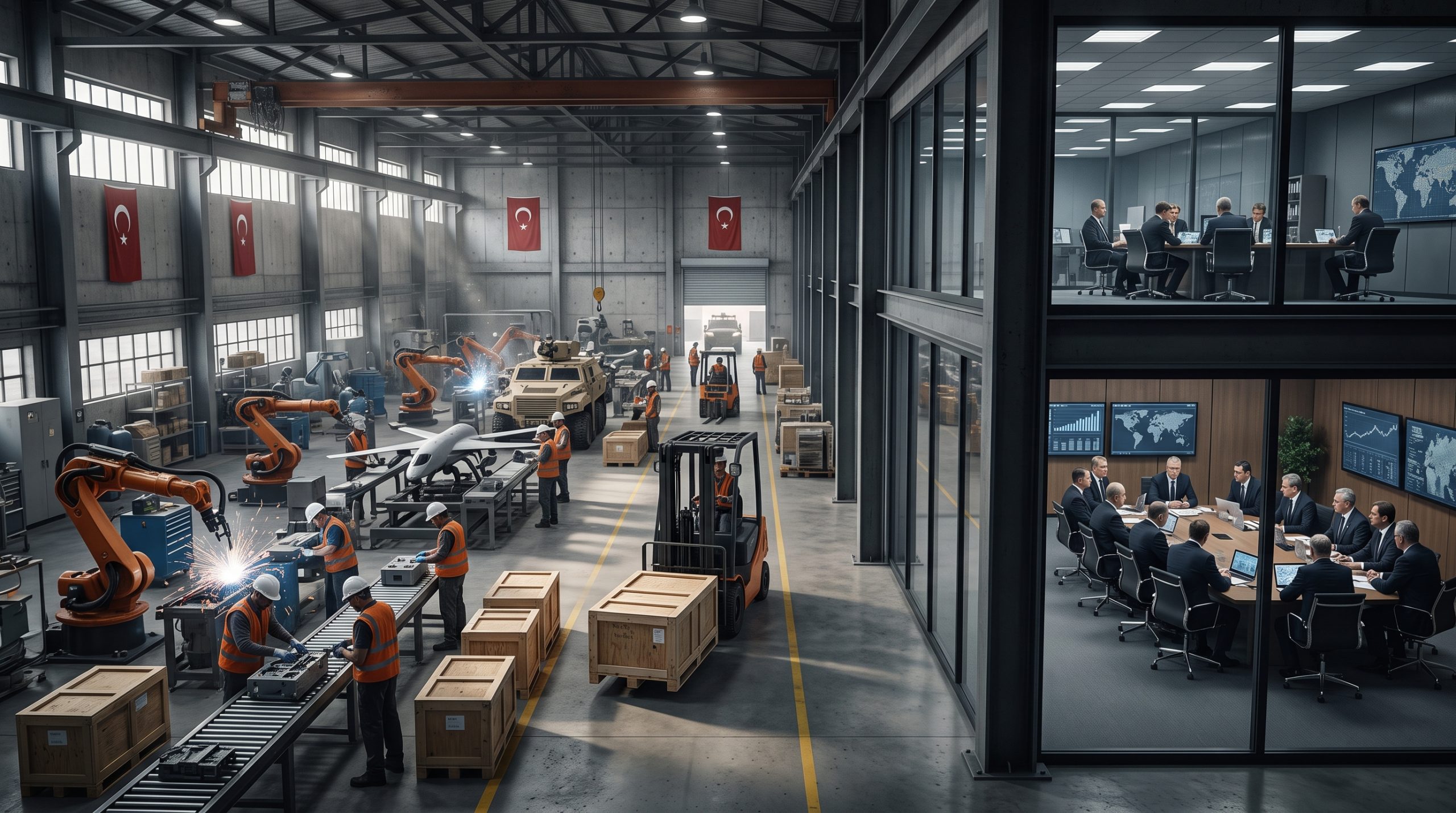
The European Defence Industry Programme came into force on 30 December 2025. A Turkish supplier can sit in an EDIP supply chain. Whether its costs can be funded, and whether its components can stay in the design, are separate questions with separate answers.
Most Turkish defence suppliers (savunma sanayii tedarikçileri) looking at the European Defence Industry Programme ask one question first: can we incorporate in a Member State and participate. The question is reasonable and the answer is more complicated than the structure suggests, because EDIP tests several different things and incorporation addresses only one of them.
Regulation (EU) 2025/2643 was adopted on 16 December 2025, published in the Official Journal of 29 December 2025 and entered into force on 30 December 2025. It carries a financial envelope of 1.2 billion euro in current prices for the period to 31 December 2027, with a further 300 million euro for the Ukraine Support Instrument. The amounts are modest beside the European defence budget as a whole. The eligibility architecture is what matters, because it is the template now being applied across EU defence industrial funding.
This article sets out where a Turkish supplier actually stands under that architecture, working from the Regulation and from the Commission’s own call conditions, which show how the rules are being applied in practice.
Why Türkiye sits outside the associated country line
EDIP divides the world in three. There are entities in the Union. There are entities in associated countries (ortak ülkeler), defined in Article 2(3) as members of the European Free Trade Association which are members of the European Economic Area and apply the Regulation in accordance with the EEA Agreement. Only Norway, Iceland and Liechtenstein can fall within that description, and only to the extent they apply the Regulation under the EEA Agreement. Everything else is a third country.
Ukraine is then carved out by name. Article 2(2) defines “another third-country entity” as a legal entity established in a non-associated third country other than Ukraine, which places Ukraine in a category of its own and leaves every other third country, Türkiye included, on the outside of the funding perimeter.
One point is worth clearing away at the start, because it comes up in almost every first conversation. Türkiye’s status as an EU candidate country (aday ülke) does not assist here. Candidate status carries weight under other instruments, as set out further below. Under EDIP the relevant definition is the associated country definition in Article 2(3), and it reaches EFTA states that are EEA members and no one else.
The executive management test, and why an EU subsidiary is not the answer
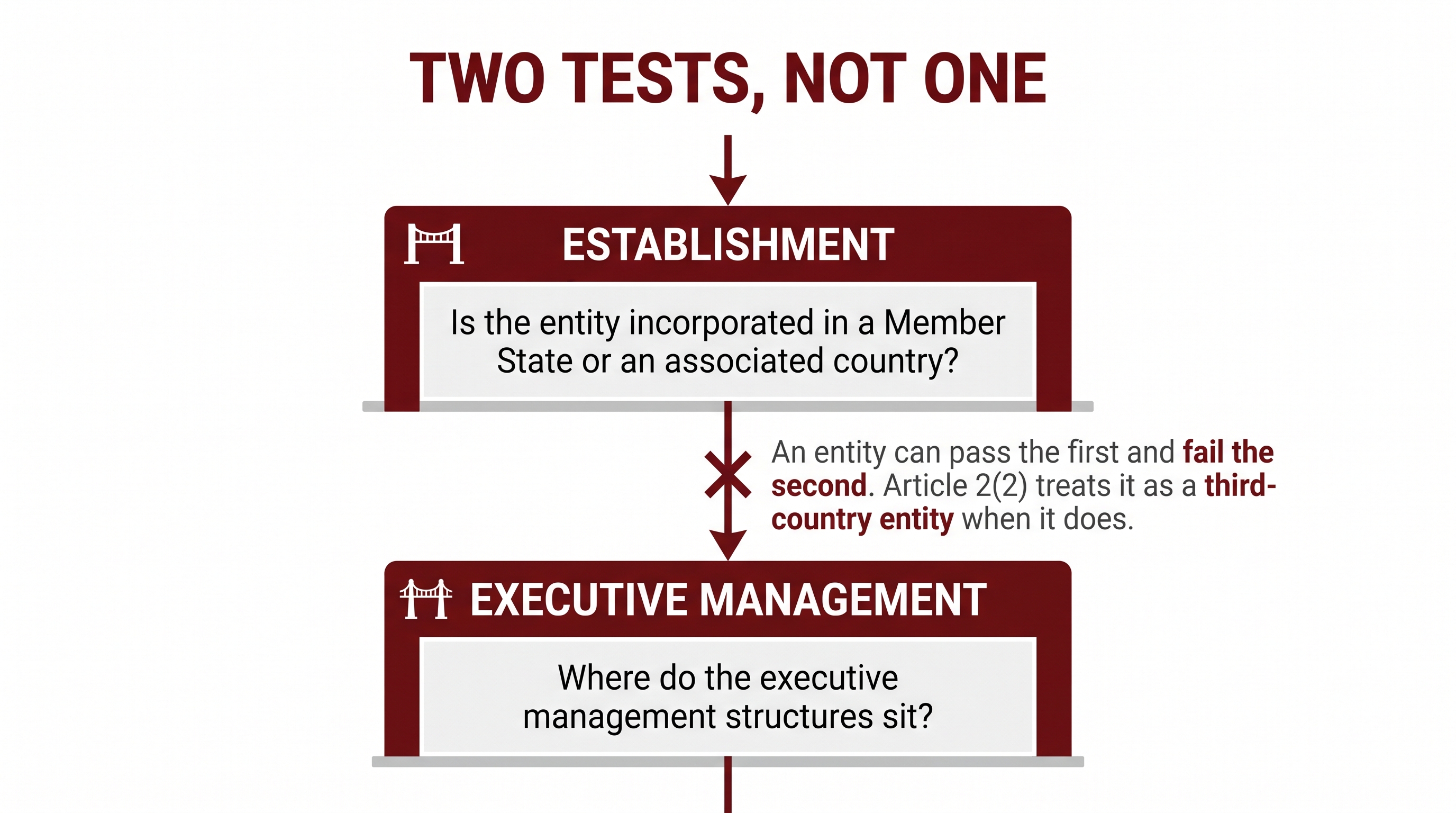
Here is the provision that defeats the most common structure. Article 2(2) does not stop at where an entity is incorporated. It also treats as “another third-country entity” a legal entity established in the Union, in Ukraine or in an associated country whose executive management structures (yürütme yönetim yapıları) are in a non-associated third country other than Ukraine.
Read that against the usual plan. A Turkish group incorporates a subsidiary in a Member State, capitalises it, registers it and treats the entity as European for programme purposes. If the people who actually run that subsidiary sit in Ankara or Istanbul, and if the decisions that direct it are taken there, the subsidiary remains a third-country entity in the Regulation’s own terms. The company formation was never the test.
Article 9(1) states the positive requirement in the same two parts: an eligible entity must be established in the Union or in an associated country and must have its executive management structures there. Both limbs, not one.
This is the single most expensive misunderstanding in this area, because it is discovered late. A subsidiary can be incorporated, staffed and presented in a consortium before anyone examines where its executive decisions are in fact taken, and that examination happens at the eligibility stage, when the consortium is already formed and the proposal already written.
Control, and the guarantees route
A third test sits alongside the first two. Article 9(5) provides that recipients shall not be subject to control (kontrol) by a non-associated third country or by a non-associated third-country entity, and Article 2(8) defines control as the ability to exercise decisive influence over a legal entity, directly or indirectly through intermediate legal entities. Decisive influence is a wider concept than majority shareholding, and intermediate holding structures do not interrupt it.
Unlike the executive management test, control admits of a remedy. The Commission’s EDIP call conditions describe two routes. One is the exemption provided for in Article 9(9). The other is guarantees (güvenceler) approved by the Member State or associated country in which the entity is established, under Article 9(6), and those guarantees may rest on a foreign direct investment screening (doğrudan yabancı yatırım taraması) carried out by that Member State with adequate mitigation measures attached. The call conditions require the guarantees to be in place by grant signature at the latest, and an ownership control assessment to be completed before signature.
Two consequences follow for a Turkish parent. The guarantees route runs through the national authorities of the Member State of establishment, not through Brussels, so the structuring question is a Member State question and the answer differs between Member States. And guarantees address control. They do not relocate executive management. An entity can be cleared on control and still fail Article 2(2) because its executive management structures remain in Türkiye.
COMPANY A
Company A is a Turkish manufacturer of subsystems with an established export record. It incorporates a subsidiary in a Member State, funds it, hires locally and joins a consortium forming around an EDIP call. The subsidiary is wholly owned by the Turkish parent and its board meets in Türkiye, where investment, pricing and programme decisions are taken.
At the eligibility stage two issues surface together. The subsidiary is controlled by a non-associated third-country entity, which is capable of being addressed through guarantees approved by the Member State. Its executive management structures are also in Türkiye, which is not addressed by those guarantees and is not addressed by anything in the ownership chain.
The remedy for the second issue is substantive rather than documentary. It means relocating the functions that direct the entity, with the authority, the people and the decision record to match. That is a corporate reorganisation with tax, employment and group governance consequences, and it is a decision to take before a consortium is formed, not during proposal preparation.
Where the work is done, and whose costs are eligible
Eligibility of the entity is one layer. Eligibility of the cost (uygun maliyet) is another, and a Turkish supplier that is not a beneficiary can still be affected by it.
Article 9 requires the infrastructure, facilities, assets and resources used for the action to be located in a Member State or an associated country for the duration of the action. A derogation exists where no readily available alternative exists in the Union or an associated country, subject to the granting authority’s agreement and to the use not being contrary to the security and defence interests of the Union and its Member States. The derogation permits the use. It does not fund it. The Commission’s call conditions state the point plainly: costs linked to assets, infrastructure or resources located or held outside eligible countries are not eligible, even where their use has been authorised.
The same logic reaches subcontracting. Under the call conditions, subcontracted work is to be performed in eligible countries, subcontractors (alt yükleniciler) must register and submit an ownership control declaration, and subcontracting above thirty per cent of total eligible costs requires justification. An entity that cannot meet the establishment and control conditions may still take part as an associated partner, exceptionally and with the granting authority’s agreement, but without Union funding.
That last sentence is the whole commercial position in one line. Participation in the supply chain is possible. Funding of the participation is not. A Turkish supplier negotiating with an EU prime should understand that it is negotiating for a share of the prime’s own unfunded budget rather than for a share of the grant, and should price accordingly.

The consortium problem: affiliated entities and subcontracting
A Turkish supplier reading the Regulation naturally asks what it means for its own position. The prime contractor asks a different question, and it is the one that decides whether the conversation continues.
The Commission’s call conditions apply the establishment, executive management and control requirements not only to beneficiaries but to their affiliated entities. A European company that holds a Turkish-controlled affiliate, or that proposes to bring one into the action, therefore carries the assessment into its own consortium rather than keeping it at arm’s length. The practical consequence is that a prime evaluating a Turkish partner is evaluating a risk to its own eligibility, not simply assessing a supplier.
Two further conditions in the same documents shape how that evaluation runs. Subcontractors are required to register and submit an ownership control declaration, so the ownership chain of a Turkish supplier becomes visible to the granting authority even where the supplier is several steps down the chain. And subcontracting above thirty per cent of total eligible costs has to be justified, which limits how much of a funded action can be pushed outward in any event.
For a Turkish supplier the useful inference is about preparation rather than entitlement. The ownership chain, the governance record and the control position will be examined, by a counterparty with its own eligibility at stake, early in the commercial conversation. A supplier that can present that material clearly and consistently at first contact is a materially easier partner to include than one that cannot, whatever the underlying merits of the technology.

The 35 per cent ceiling, and how it is actually calculated
Article 10(3) provides that the cost of components originating outside the Union and associated countries shall not exceed 35 per cent of the estimated cost of the components of the end product (nihai ürün). The same condition is sometimes expressed from the other side, as a requirement that at least 65 per cent of the component cost originate in the Union or an associated country. The two formulations are arithmetically identical and the second is the more common in commentary, which is one reason the denominator is so often misstated.
The denominator is what most summaries get wrong, and it is worth stating precisely. The figure is not a share of total project costs and not a share of the price of the finished product. It is a share of the estimated cost of that product’s components (bileşenler). The Commission’s call conditions set out two acceptable methods, and compliance with either is sufficient. Under the first, the numerator is the cost of tier one procured components originating outside the Union and associated countries and the denominator is the estimated cost of all tier one procured components regardless of origin. Under the second, the same numerator is measured against a denominator that adds the total manufacturing cost of in-house subsystems to the tier one components ready for direct integration, with final assembly costs excluded. Directly procured raw materials fall outside the component cost in either method, and the condition must hold for the entire duration of the action.
For a Turkish supplier this is the number that determines how much room exists. Thirty five per cent is a ceiling shared with every other non-associated source in the product, so the real question in any negotiation is not whether a Turkish component can be included but how much of a finite allowance it consumes and who else is competing for the same allowance.
Article 10(5), and the component that cannot be removed
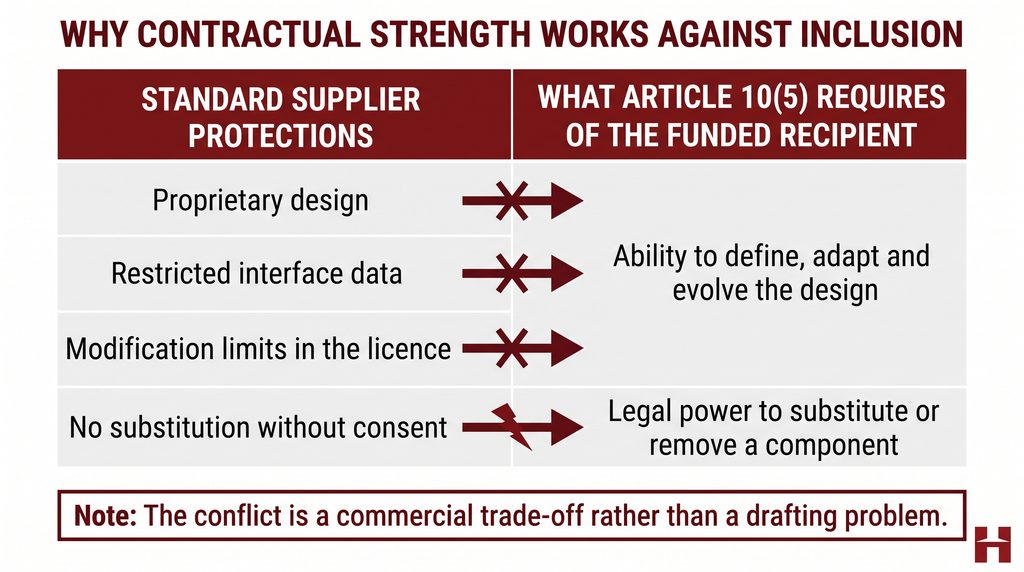
The provision that will decide the most commercially significant cases is not the percentage. It is Article 10(5), which requires a recipient of Union funding to be able to decide on the definition, adaptation and evolution of the design of the defence product, including the legal power to substitute or remove a component.
Set that against how a specialised supplier normally protects its position. Proprietary design, restricted interface documentation, a licence that limits modification, a contractual requirement that the component remain in the configuration: these are the ordinary tools by which a supplier converts technical capability into durable commercial advantage. Under Article 10(5) each of them becomes a reason why the prime cannot satisfy the condition.
The effect is uncomfortable and should be stated directly. The stronger a supplier’s contractual lock on its own component, the harder it becomes for a funded prime to keep that component in the design. What protects the supplier commercially is precisely what disqualifies the product. A Turkish supplier that wants to be in these programmes has to decide which of the two it values more, and the decision belongs at the term sheet rather than at the eligibility check.
COMPANY B
Company B supplies a specialised subsystem to European integrators under terms refined over a decade. The licence restricts modification, interface data is released only as needed, and the supply agreement provides that the subsystem is not to be substituted without consent. The terms have protected the business and are regarded internally as settled.
An EU prime invites Company B into an EDIP funded action. The commercial conversation goes well. The legal review does not, because the prime must be able to show that it can decide on the definition, adaptation and evolution of the design, including substituting or removing the subsystem. Company B’s standard terms say the opposite in three places.
The question is then which side gives way, and it is a pricing question rather than a legal one. Company B can hold its terms and remain outside the funded programme while continuing to supply unfunded work, or it can accept a narrower contractual position for programmes of this kind and price the increased substitution risk into those contracts. Both are defensible. What does not work is discovering the conflict after the consortium agreement has been signed.
SAFE is a different instrument, with different rules
Turkish suppliers frequently raise EDIP and SAFE in the same conversation, and the two should be kept apart. SAFE is the Union’s loan instrument of up to 150 billion euro, which entered into force on 29 May 2025. Only Member States can take the loans. Ukraine and EEA and EFTA states can join common procurements with Member States, acceding, candidate and potential candidate countries may participate in common procurement, and countries that have concluded a Security and Defence Partnership with the Union may participate on that basis. Canada’s industry became able to take part following a bilateral agreement concluded in June 2026.
Two practical points follow. Candidate country status is capable of mattering under SAFE in a way it does not under EDIP, where the associated country definition is closed. And a 35 per cent figure appears in both instruments, which is a frequent source of confusion, since SAFE applies its limit to component costs in a procurement contract while EDIP applies Article 10(3) to the estimated cost of the components of the end product in a funded action. The figure is the same. The instrument, the perimeter and the calculation are not, and a company that satisfies one has not thereby satisfied the other.
Türkiye’s position under SAFE has been the subject of continuing discussion between the Union and Ankara, and no bilateral arrangement had been concluded as at the middle of 2026. That position should be checked at the time of any specific transaction rather than assumed from a previous one.
What a Turkish supplier can actually do
Three routes exist and they are not alternatives so much as different levels of ambition.
The first is to supply as an unfunded participant, accepting that the work can be performed but the cost will sit with the prime. This requires nothing structural. It requires an accurate commercial understanding, a clear position on where the work is performed, and pricing that reflects the absence of grant support.
The second is to supply components within the 35 per cent allowance, which turns on the prime’s component mix rather than on anything the supplier controls. The useful preparation here is evidentiary. A supplier that can produce a clear component cost breakdown, on the basis the Commission’s two methods use, is easier to accommodate within a finite allowance than one that cannot.
The third is to establish a genuinely eligible entity. That means establishment in a Member State, executive management structures actually located there, and a control position that either falls outside Article 9(5) or is addressed by guarantees approved by that Member State, with foreign direct investment screening and mitigation measures where required. It is a corporate and governance exercise with real cost, and it should be assessed against the size of the opportunity before it is begun.
HERDEM advises Turkish defence and technology groups on the Turkish side of these structures: assessing the executive management and control position against Articles 2(2), 2(8) and 9, preparing the governance and documentary record that an ownership control assessment will examine, reviewing supply and licence terms against the design autonomy requirement in Article 10(5) before they are signed, and advising on export control and authorisation requirements on the Turkish side of any transfer. Structuring in a Member State and guarantees before its authorities are matters for counsel qualified in that Member State, and are best organised as a joint exercise from the outset.

The question worth asking now
EDIP runs to the end of 2027 and its eligibility architecture is already being carried into later instruments. The practical significance of the Regulation is therefore larger than its envelope, because the definitions in Article 2 and the conditions in Articles 9 and 10 are becoming the standard test of whether a supplier is inside or outside European defence industrial funding.
The question worth putting to a board is narrower than it first appears. If a European prime asked tomorrow whether the company can sit inside a funded action, who would answer, what would they look at, and would the answer rest on where the company is incorporated or on where its executive decisions are actually taken and what its standard supply terms actually say? Those two documents, the governance record and the standard terms, decide the outcome. Both can be put in order in advance. Neither can be put in order once a consortium has formed.
This article reflects Regulation (EU) 2025/2643 as published in the Official Journal of 29 December 2025 and the European Commission’s published EDIP call conditions, together with publicly available material on the SAFE instrument, as at October 2026. Company A and Company B are composite illustrations constructed from publicly documented fact patterns and do not describe identifiable persons or matters. This article is provided for general informational purposes and does not constitute legal advice on any specific matter.