
 TR-TR
TR-TR  EN-US
EN-US 
It should be noted that Türkiye has become one of the most active public procurement markets in its region, with record defense expenditure, sustained infrastructure investment, and an accelerating programme of digitalisation across the entire tender lifecycle. For foreign companies, and particularly for those operating in the defense, aerospace, machinery, and logistics sectors, the commercial opportunity is considerable. Yet the same companies frequently discover that winning, or even lawfully contesting, a Turkish public tender requires command of a procedural architecture that differs in important respects from the regimes they know at home. This article sets out, in practical terms, how the Turkish bid protest system operates under the Public Procurement Law No. 4734 (the “PPL”), how eligibility rules apply to foreign tenderers, and what has changed as of 2026.
The Legal Framework and Its Boundaries
The PPL, in force since 2003, governs the procurement of goods, services, and works by contracting authorities within its scope, including general and special budget administrations, municipalities, state owned enterprises, and various public institutions. Oversight of the regime is entrusted to the Public Procurement Authority (Kamu İhale Kurumu, the “KİK”), an administratively and financially autonomous body whose Public Procurement Board issues binding decisions on review applications. Procurement procedures are conducted through the Electronic Public Procurement Platform (Elektronik Kamu Alımları Platformu, “EKAP”), and it should be emphasised that the scope of mandatory electronic tendering has been progressively expanded, meaning that foreign tenderers must be registered on EKAP and technically capable of submitting electronic bids well before any deadline approaches.
In this regard, a preliminary question that foreign companies in the defense sector must always resolve is whether the tender in question falls within the PPL at all. Article 3 of the PPL contains a series of exceptions, and defense procurement is frequently conducted outside the ordinary regime, notably where procurement relates to defense, security, or intelligence requirements whose disclosure would be contrary to national security, or where procurement is carried out by the Presidency of Defence Industries under its own procedures. The practical consequence is significant: the bid protest mechanism described in this article is available only for tenders conducted under the PPL, whereas exempted defense procurements follow contractual and administrative routes of their own. A tenderer that assumes KİK jurisdiction where none exists will lose valuable time, and a tenderer that fails to invoke KİK review where it does exist will forfeit rights that cannot later be revived. With this respect, jurisdictional analysis is not a formality; it is the first strategic decision in any contested Turkish tender.
Eligibility of Foreign Tenderers: Thresholds, Price Advantage, and Documentation
Article 4 of the PPL defines a “domestic tenderer” as a natural person who is a citizen of the Republic of Türkiye or a legal entity established under Turkish law. All other bidders are foreign tenderers, and their access to a given tender is determined principally by the threshold values (“eşik değerler”) set out in Article 8 of the PPL and updated each year by KİK communiqué.
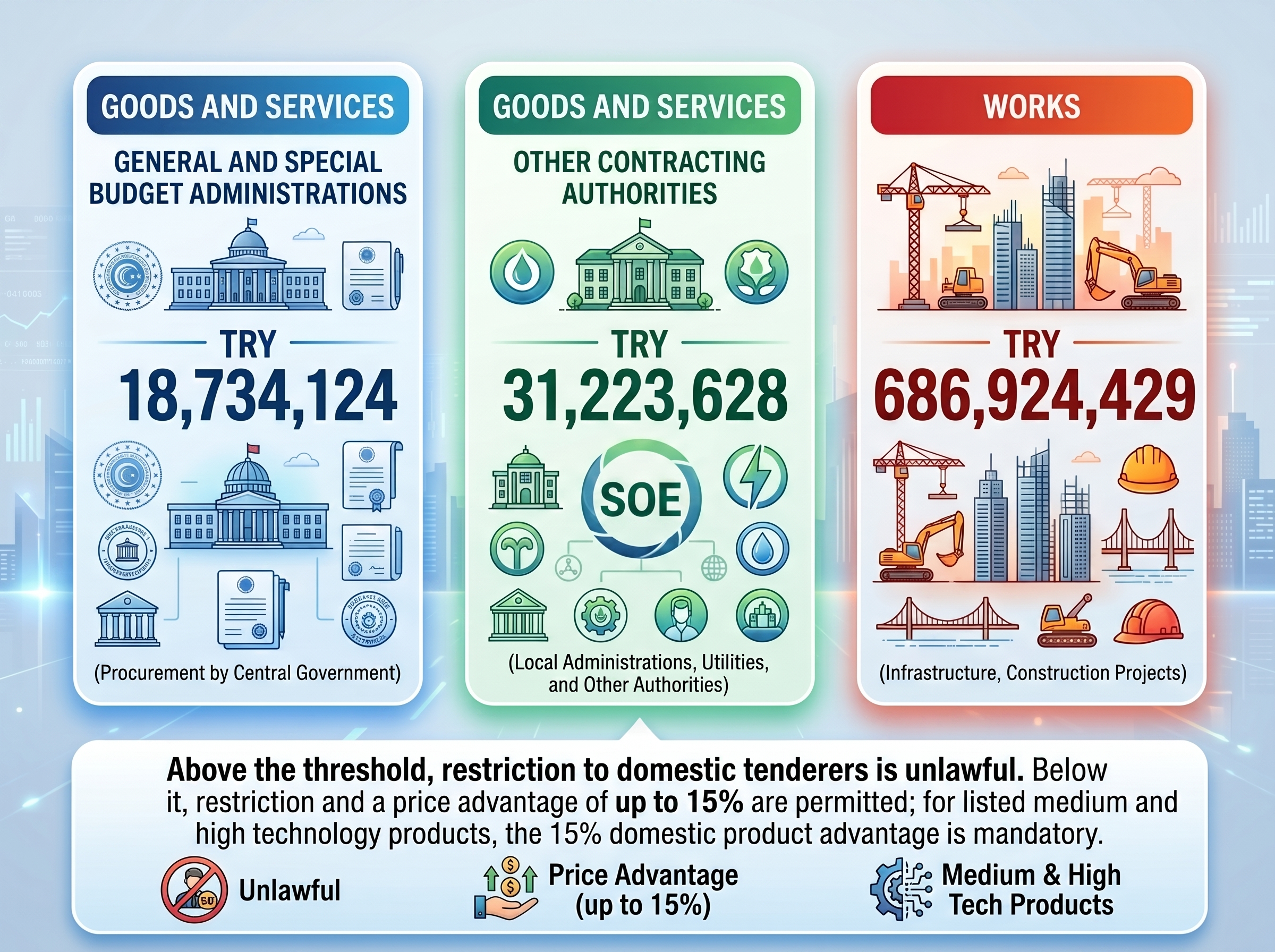
Under Article 63 of the PPL, contracting authorities may restrict participation to domestic tenderers in service and works tenders whose estimated cost falls below the applicable threshold, and they may grant a price advantage of up to fifteen percent in favour of domestic tenderers, and in goods tenders in favour of bidders offering domestically manufactured products. It should be emphasised that in goods tenders concerning products included in the list of medium and high technology industrial products published annually on the basis of the relevant Ministry determinations, the application of the fifteen percent price advantage in favour of domestic products is not discretionary but mandatory. For foreign manufacturers of defense equipment, machinery, and electronic systems, this single rule frequently determines the commercial viability of bidding directly rather than through a structure that qualifies the offered product as domestic. Whether a tender is open to foreign participation and whether a domestic price advantage will be applied must be stated in the tender notice and the administrative specifications; the KİK has consistently held that a tender whose estimated cost exceeds the threshold cannot lawfully be confined to domestic bidders, and such a restriction is itself a ground of challenge.
For 2026, pursuant to Public Procurement Communiqué No. 2026/1 published in the Official Gazette on 22 January 2026 and applicable from 1 February 2026, the threshold values were updated by reference to the domestic producer price index. The threshold for goods and services procurement by general and special budget administrations now stands at TRY 18.734.124, the threshold for goods and services procurement by other contracting authorities at TRY 31.223.628, and the threshold for works at TRY 686.924.429. It should be noted that these figures are revised annually, and that any tender strategy built on the previous year’s values risks a fundamental miscalculation of both eligibility and protest economics.
Beyond thresholds, foreign tenderers must attend closely to documentation. Corporate documents, signature authorities, financial statements, and work experience certificates issued abroad must be apostilled or legalised and submitted with sworn Turkish translations, and equivalence questions regularly arise where a foreign qualification document does not map neatly onto the categories contemplated by the implementing regulations. Joint ventures between foreign and Turkish companies are a common and often advisable structure, both to satisfy experience criteria and to benefit from local execution capacity, but the joint venture agreement, the allocation of the pilot partner role, and the attribution of work experience among partners are all recurrent grounds on which bids are eliminated and on which eliminations are challenged. In our practice, we have advised a European manufacturer of industrial equipment whose bid documentation, prepared to the standard of its home jurisdiction, required substantial restructuring to satisfy Turkish formal requirements, and we have supported a leading Turkish distributor of heavy machinery and power systems throughout the preparation and submission of a tender valued at approximately EUR 120 million, where eligibility, qualification, and confidentiality requirements imposed by the procuring authority demanded careful legal navigation before any question of award even arose.
The Three Tiers of Review
The Turkish bid protest system is constructed in three sequential tiers, and the sequence is mandatory. A tenderer cannot leap directly to the KİK, still less to the courts, without first exhausting the tier below.
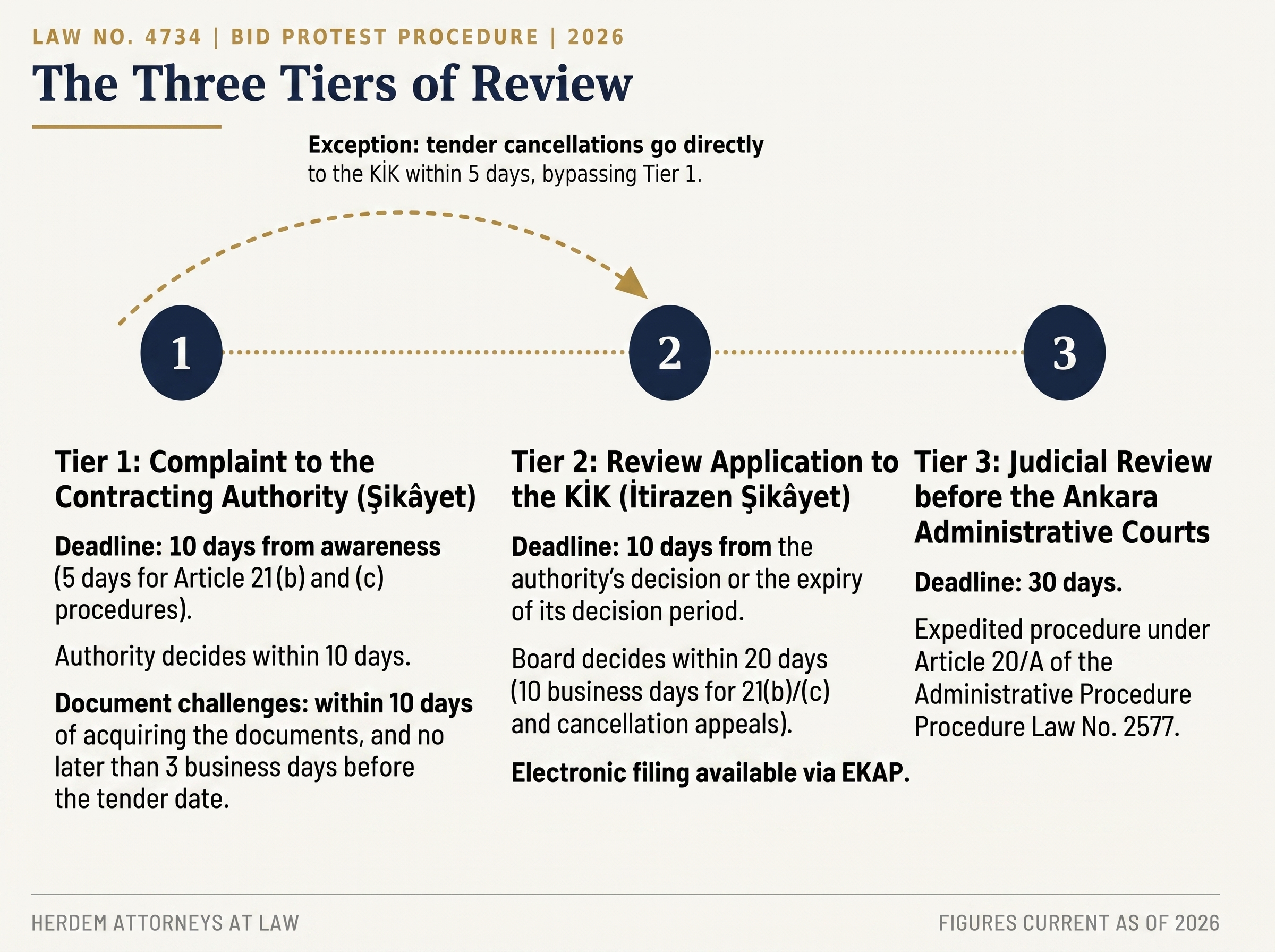
The first tier is the complaint (“şikâyet”) to the contracting authority under Article 55 of the PPL. The complaint must be lodged within ten days of the date on which the applicant became aware, or ought to have become aware, of the act or omission alleged to be unlawful, with a shortened period of five days applying in certain negotiated procedures conducted under Article 21(b) and (c) of the PPL. Challenges directed at the tender documents themselves are subject to their own timing discipline: under the Regulation on Applications Concerning Tenders, the complaint must be lodged within ten days of the acquisition of the documents and in any event no later than three business days before the tender date. It is a settled principle of KİK practice that a tenderer which submits a bid without contesting the documents is thereafter deemed to have accepted them. The contracting authority must decide the complaint within ten days.
The second tier is the review application (“itirazen şikâyet”) to the KİK under Article 56 of the PPL. This application must be filed within ten days of the notification of the contracting authority’s decision, or of the expiry of the period within which the authority was required to decide. An important exception to the mandatory sequence must be noted: where the contracting authority cancels the tender, the challenge is directed to the KİK itself within five days of the notification of the cancellation decision, without a prior complaint to the authority. Foreign tenderers should also be aware that review applications may be filed electronically through EKAP, a facility of considerable practical value for companies coordinating protest decisions from abroad against tight statutory deadlines. The Public Procurement Board renders its final decision within twenty days of the completion of the file, shortened to ten business days for tenders conducted under Article 21(b) and (c) and for applications directed against the cancellation of a tender. The Board may reject the application, order corrective action, or cancel the tender, and its decisions are binding on the contracting authority. It should be emphasised that the review application is fee based, that the fee is tiered according to the estimated cost of the tender, and that the petition itself is a technical pleading: the Board examines the claims as framed, and claims not raised are, as a rule, not examined, subject to the Board’s separate review on the principle of equal treatment.
The third tier is judicial review. Decisions of the Public Procurement Board are administrative acts subject to annulment proceedings before the administrative courts of Ankara, and procurement disputes are heard under the expedited procedure introduced by Article 20/A of the Administrative Procedure Law No. 2577, which compresses the ordinary litigation timetable, shortens the period for filing to thirty days, and restricts certain procedural steps in the interest of speed. For foreign tenderers, the availability of expedited judicial review is a meaningful safeguard, but it is also a discipline: the record on which the court will rule is substantially the record built before the contracting authority and the KİK, which is why the quality of the initial complaint and the review petition determines, to a considerable degree, the prospects of the entire protest.
What Changed in 2026: Fees, Refunds, and the Justification Rate
Two developments make 2026 a year in which the economics of bid protests in Türkiye must be recalculated.
First, the review application fees payable to the KİK were updated with effect from 1 February 2026, again by reference to the producer price index. Under the current schedule, the fee amounts to TRY 64.652 for tenders whose estimated cost does not exceed TRY 10.785.492, TRY 129.385 for tenders up to TRY 43.142.132, TRY 194.085 for tenders up to TRY 323.566.103, and TRY 258.810 for tenders whose estimated cost equals or exceeds that figure. In partial tenders, the fee is calculated on the total estimated cost, with any excess refunded once the estimated cost of the contested part is established. For high value defense and infrastructure tenders, the fee is a material cost of the protest and must be budgeted as such.
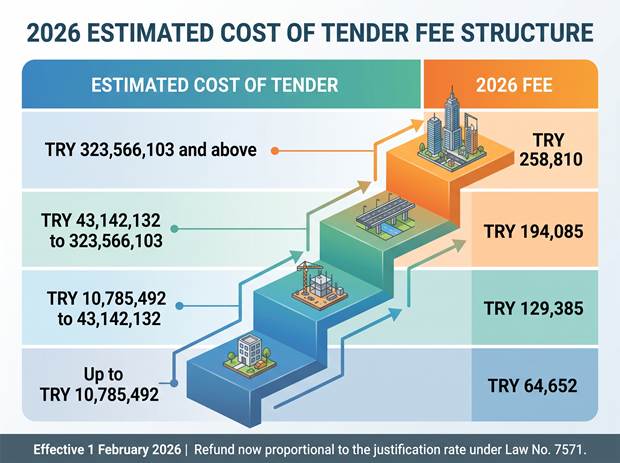
Second, and more consequentially, Law No. 7571, published in the Official Gazette on 25 December 2025 and in force as of 26 December 2025, amended the fourth and fifth paragraphs of Article 53(j) of the PPL and thereby restructured the refund regime for review application fees. Under the amended provision, the fee is refunded to the applicant in proportion to a “justification rate” (“haklılık oranı”) determined by reference to the claims set out in the review petition. No refund is made where the application is rejected on the merits, nor where the cancellation of the tender or the determination of corrective action results solely from the Board’s own examination under the principle of equal treatment rather than from the applicant’s claims. The amendment further provides that where a single claim in the petition contains several distinct points, each point is assessed by the KİK as a separate claim. The Board implemented the new regime through its decisions of 26 December 2025 numbered 2025/DK.D473 and 2025/DK.D474, together with amendments to the directive governing fee refunds, and a parallel framework now governs the refund of the KİK share collected on contract values where a contract is terminated without contractor fault.
The practical import of the justification rate mechanism deserves emphasis. Under the previous practice, an applicant whose petition succeeded on any ground could expect recovery of the fee. Under the current regime, every claim in the petition is individually priced: a petition containing ten claims of which two are upheld yields a refund proportionate to those two, and a petition drafted expansively, in the hope that some claim will find favour, now carries a direct financial cost for every claim that fails. In this regard, the amendment rewards precisely the kind of disciplined, evidence based pleading that experienced procurement counsel has always favoured, and penalises the scattergun petition. For foreign tenderers, whose claims frequently concern technically dense questions of qualification criteria, equivalence of foreign documents, or abnormal low bid analysis, the selection and framing of claims has become a matter of both legal and financial strategy.
Strategic Considerations for Foreign Tenderers
Several practical lessons emerge from the framework described above, and from our experience advising both foreign bidders entering Turkish tenders and Turkish companies facing challenges from competitors.
The first is that the protest begins before the bid. The most valuable challenges are frequently those directed at the tender documents, whether at qualification criteria calibrated to favour a particular bidder, at an unlawful restriction to domestic tenderers in an above threshold procurement, or at technical specifications drafted around a single product. Once bids are submitted, those arguments are, as a rule, lost. A foreign tenderer should accordingly subject the tender notice and specifications to legal review immediately upon publication, with the ten day clock in mind.
The second is that standing and timing are unforgiving. The periods of ten days, and five days in the relevant negotiated procedures, are calculated strictly, the mandatory sequence of tiers admits no shortcuts, and an application filed at the wrong tier or out of time will be rejected without examination of the merits. Foreign companies coordinating decisions across time zones and internal approval chains should build these constraints into their tender governance from the outset.
The third is that the petition is the case. The Board decides the claims before it, the justification rate now attaches a cost to every claim advanced, and the administrative courts will review the Board’s decision on substantially the same record. Investment in the initial pleading, including translated evidence, technical annexes, and precise legal grounds, is investment in every subsequent stage.
The fourth is that eligibility engineering is legitimate and often decisive. The choice between bidding directly, through a Turkish subsidiary, or through a joint venture with a Turkish partner affects the applicability of the domestic price advantage, the attribution of work experience, and the documentary burden. We have repeatedly seen tenders won and lost on structuring decisions taken months before the tender date, and we have advised clients in the defense and machinery sectors on representation and cooperation arrangements designed, from the first draft, with future tender eligibility in view.
Conclusion
Türkiye’s public procurement market offers foreign tenderers genuine scale, particularly across the defense, infrastructure, and industrial sectors, and the PPL provides a structured, fee based, and increasingly digitalised protest mechanism through which unlawful tender conditions and award decisions can be contested within weeks rather than years. The 2026 updates to threshold values and application fees, and above all the justification rate regime introduced by Law No. 7571, have sharpened the incentives toward early, precise, and well evidenced challenges. For companies prepared to engage with the system on its own procedural terms, the bid protest is not a remedy of last resort; it is an instrument of tender strategy. Herdem Attorneys at Law advises international and Turkish clients across every stage of that strategy, from eligibility structuring and document review to complaint, review application, and expedited judicial proceedings.
This article is provided for general information purposes only and does not constitute legal advice. For advice on a specific tender or dispute, please contact the author.