
 TR-TR
TR-TR  EN-US
EN-US 
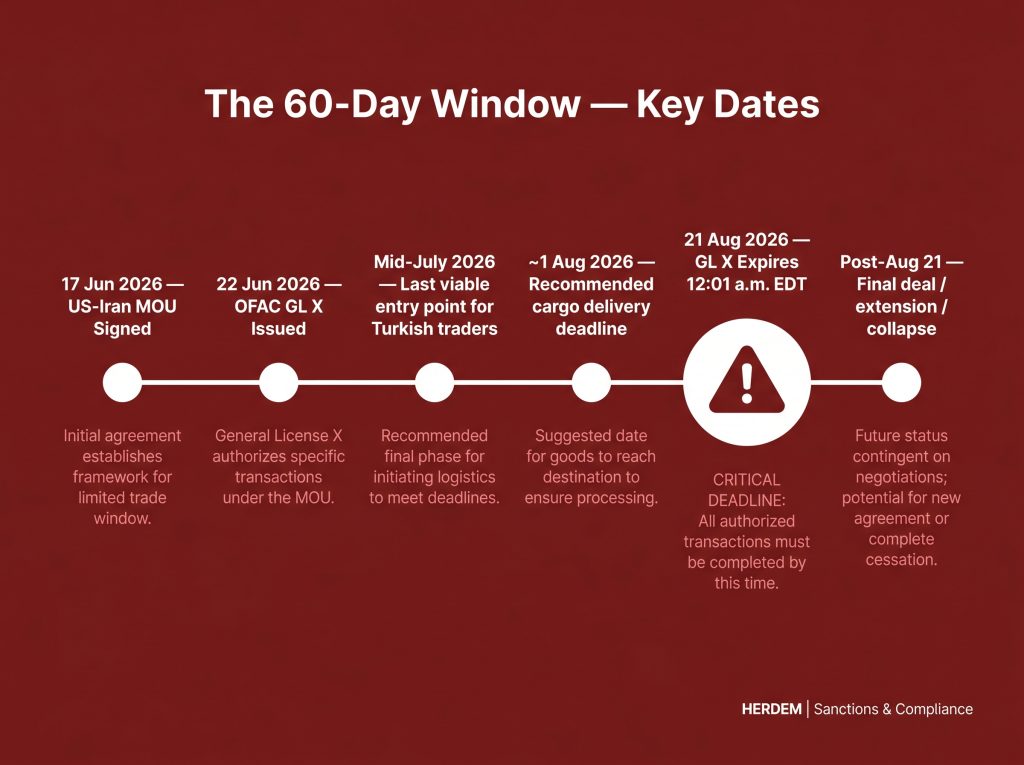
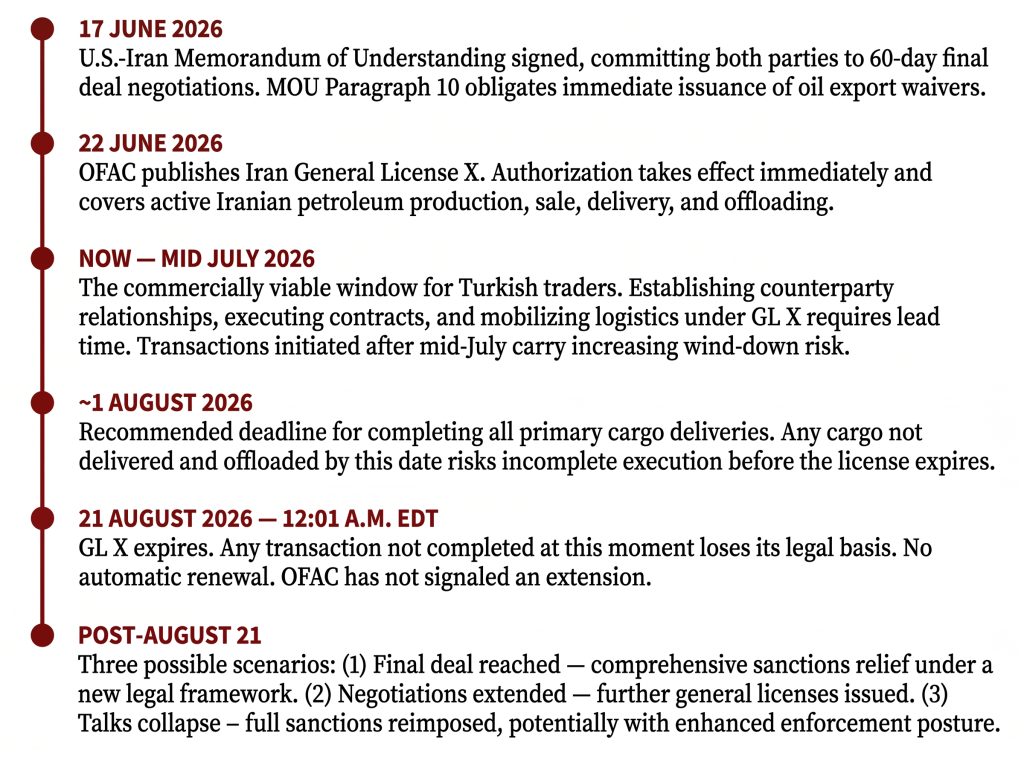
On 22 June 2026, the United States Treasury’s Office of Foreign Assets Control (OFAC) published Iran General License X (GL X) — a sweeping, time-limited authorization for the production, sale, delivery, and offloading of Iranian-origin crude oil, petrochemical products, and petroleum products. The license runs through 12:01 a.m. Eastern Daylight Time on 21 August 2026: exactly sixty days from its issuance, mirroring the diplomatic timeline under which U.S. and Iranian negotiators have committed to reaching a final comprehensive agreement.
For Turkish energy traders, refiners, shipping companies, and the banks that service them, GL X represents the most commercially significant sanctions development in years. Turkey has long sat at the intersection of Iranian energy flows and Western financial infrastructure — a position that has brought both lucrative opportunity and considerable legal exposure. GL X does not change that structural tension. What it does is temporarily rebalance the equation, providing a clear legal pathway to transact in Iranian energy that did not exist two weeks ago.
This article explains what GL X authorizes, what it does not, why Turkey is uniquely positioned to act on it, and the compliance architecture that any serious market participant must have in place before moving.
The Geopolitical Context You Cannot Ignore
GL X did not emerge from a policy vacuum. It is the direct commercial implementation of a Memorandum of Understanding signed on 17 June 2026 between the United States and the Islamic Republic of Iran, ending a period of direct military conflict that had erupted in February of this year. That conflict — and Iran’s resulting closure of the Strait of Hormuz — triggered what the International Energy Agency described as the largest supply disruption in recorded history, with global oil output falling by roughly 10 million barrels per day in March alone. WTI crude had breached $100 per barrel. The disruption was not an abstraction for Turkish refineries; it was an existential supply-chain crisis.
The MOU commits both parties to a 60-day negotiating period toward a final deal. On the U.S. side, Paragraph 10 of the MOU specifically obligated Treasury to issue waivers for Iranian crude oil exports “immediately upon signing.” GL X is that waiver, operationalized through OFAC’s regulatory architecture. The Strait of Hormuz has partially reopened — though the main channel reportedly remains mined — and Iran has committed to IAEA inspector access as part of the framework.
Treasury Secretary Scott Bessent announced GL X alongside the diplomatic framework emerging from talks in Switzerland. The market responded immediately: WTI dropped approximately 3% on the news, with Brent settling near $77 per barrel. For Turkish buyers who had been paying crisis premiums, that repricing alone is commercially significant.
“For Turkish companies that have spent years navigating the shadow economy of Iranian crude, GL X offers something unprecedented: a legal framework that is, for sixty days, unambiguous.”
What GL X Actually Authorizes — and for Whom
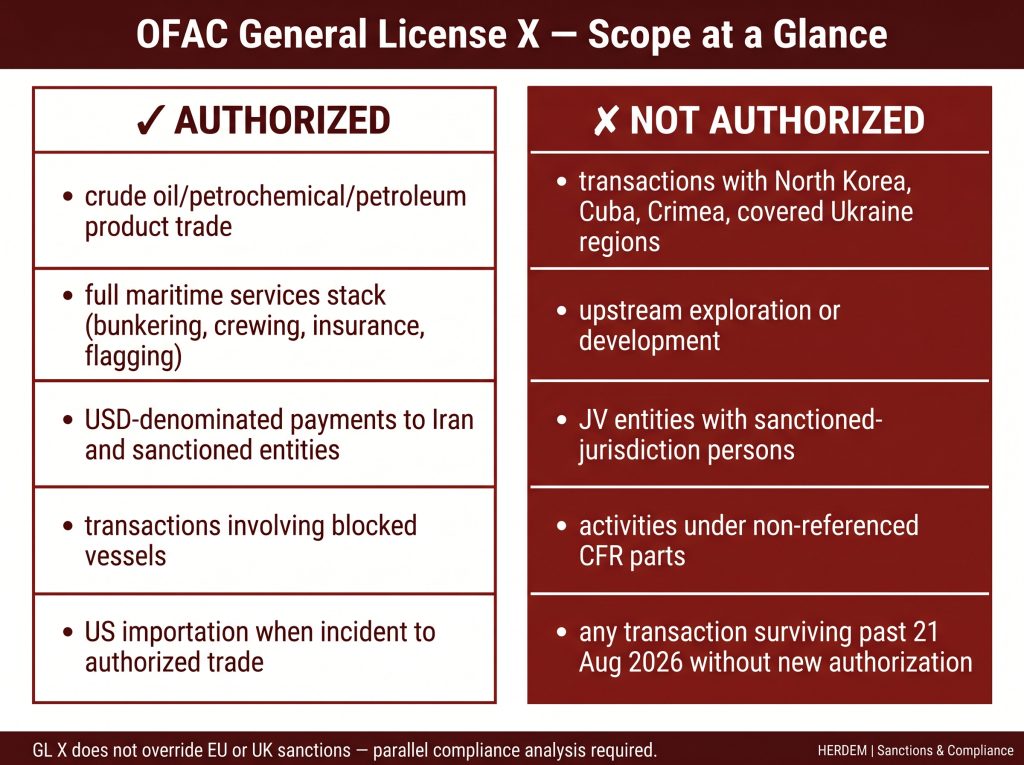
The license is deliberately broad in its commercial scope. It authorizes all transactions that are “ordinarily incident and necessary” to the production, sale, delivery, or offloading of Iranian-origin crude oil, petrochemical products, and petroleum products. That phrase — “ordinarily incident and necessary” — is OFAC’s standard formulation for covering the full commercial stack surrounding a transaction, not merely the headline trade.
The license explicitly includes: safe docking and anchoring of vessels carrying Iranian cargo; preservation of crew health and safety; emergency repairs; environmental mitigation; and the full suite of maritime services including vessel management, crewing, bunkering, piloting, registration, flagging, insurance, classification, and salvage. In other words, a Turkish ship manager, a Turkish P&I club, a Turkish bunkering company, or a Turkish flagging registry can participate in the authorized chain without separately analyzing whether each service falls within scope.
Critically, GL X covers Iranian-origin products produced by entities sanctioned under the Iranian Transactions and Sanctions Regulations, the Iranian Financial Sanctions Regulations, and the Global Terrorism Sanctions Regulations. This is a significant departure from prior authorization frameworks: it means that Turkish buyers are not required to screen out all OFAC-listed Iranian counterparties within the petroleum sector — the license has pre-authorized those dealings for covered transactions.
GL X also expressly permits payment in U.S. dollar-denominated funds. This is remarkable. Since 1995, it has been effectively prohibited even for non-U.S. persons to transact in Iranian oil using USD. GL X lifts that restriction for authorized transactions, opening the international banking system to a class of Iranian energy payments it has been closed to for three decades.
Scope at a Glance
The Turkish Opportunity — and Why It Is Structural, Not Incidental
Turkey’s relationship with Iranian energy is not a recent development born of geopolitical opportunism. It is a decades-long commercial reality grounded in geography, infrastructure, and economic complementarity. Turkey shares a 560-kilometer border with Iran. The Tabriz-Ankara gas pipeline has been delivering Iranian gas since 2001 under a contract — now expiring in July 2026 — for up to 9.6 billion cubic meters annually. Bilateral trade between Turkey and Iran peaked above $11 billion in 2021–2022. Turkey’s refining sector has historically processed Iranian crude. Its shipping intermediaries have serviced Iranian cargoes under varying legal frameworks for years.
What GL X creates, for the first time, is a unambiguous U.S. legal framework that Turkish companies can point to when conducting these transactions. For companies that previously operated in a grey zone — relying on Turkey’s stated policy of not enforcing unilateral U.S. sanctions — GL X replaces legal ambiguity with formal authorization. For companies that avoided Iranian crude entirely due to secondary sanctions exposure, GL X removes that exposure for the duration of the license.
The commercial opportunity is real. Iranian crude — if the Strait reopens fully — has historically traded at a discount to Brent, partly because of the sanctions premium embedded in sourcing it. Turkish refineries that can process Iranian crude grades, particularly from fields in Khuzestan, have a structural cost advantage over competitors who cannot. Turkish independent trading houses and intermediaries who can mobilize quickly, establish compliant payment channels, and service vessels carrying Iranian cargo stand to generate substantial revenue in a compressed timeframe.
The maritime dimension deserves particular attention. Turkish ship managers, operators, and technical service companies have existing relationships with vessels that have operated in Iranian waters — including vessels that may currently be listed on the OFAC SDN List. GL X explicitly extends to transactions involving blocked vessels where the underlying cargo transaction is authorized. This creates an opening for Turkish maritime operators that would not have existed under any prior authorization framework.
The Risks That GL X Does Not Eliminate
The authorization is real. The risks are also real, and Turkish compliance officers would be wrong to treat GL X as a broad sanctions holiday. Several significant exposure vectors remain live.
The IRGC Problem
The Islamic Revolutionary Guard Corps controls significant portions of Iran’s petroleum sector, including through the newly created Persian Gulf Strait Authority (PGSA), which OFAC designated under counterterrorism authorities on 26 May 2026. GL X authorizes transactions that would otherwise violate named sanctions regulations — but it does not and cannot extinguish criminal liability under U.S. counterterrorism statutes. The IRGC has been a U.S.-designated Foreign Terrorist Organization since 2019. Knowingly providing “material support” to an FTO remains a federal crime under 18 U.S.C. § 2339B, and GL X explicitly states that it does not override any other executive orders or CFR parts not referenced in the license. Any Turkish company whose transaction chain runs through IRGC-controlled entities should obtain specific legal advice before proceeding; an OFAC general license is not a shield against criminal prosecution.
EU and UK Sanctions Remain Fully Operative
GL X is a U.S. authorization. It has no legal effect on EU or UK sanctions against Iran, both of which remain comprehensively in force. Turkish companies with European banking relationships, European shareholders, subsidiaries in EU member states, or European correspondent banking access face a genuine conflict: a transaction that GL X has authorized for U.S. purposes may simultaneously violate EU Council Regulation 267/2012 or UK OFSI instruments. The European Court of Justice has consistently held that EU sanctions apply to transactions processed in euros or involving EU persons anywhere in the global chain. Turkish companies that are de facto integrated into the European financial system cannot treat GL X as a complete compliance solution.
The August 21 Cliff
GL X carries no automatic renewal provision and can be withdrawn at any time before expiry. OFAC has issued similar time-limited authorizations in this conflict cycle — GL U in March 2026 covered Iranian crude already at sea for thirty days — without extending them. Any contractual obligation entered into under GL X that cannot be completed by 12:01 a.m. EDT on 21 August will lose its legal basis at that moment and potentially expose all parties to sanctions liability from that point forward. Turkish companies should build explicit GL X validity conditionality into every contract signed under this authorization, including force majeure clauses that address license expiry.
Counterparty Contamination
GL X does not suspend the requirement to conduct counterparty due diligence. The license authorizes transactions involving certain sanctioned Iranian entities in the petroleum sector — but it does not authorize transactions involving persons in North Korea, Cuba, Crimea, or the covered regions of Ukraine, nor entities owned or controlled by those persons. Given that Iranian crude has flowed through networks involving Chinese teapot refineries, Russian-linked intermediaries, and other sanctioned-adjacent actors during the conflict period, Turkish buyers must conduct ownership and control analysis on every counterparty in the transaction chain, not merely the headline seller.
Enforcement Context: Turkey’s Exposure Is Not Hypothetical
In February 2026, OFAC designated three Istanbul-based companies — Utuş Gümrükleme, Arya Global, and Altis Tekstil — for serving as financial intermediaries in procurement networks benefiting Iran’s UAV production program. All three were established in 2024 as single-owner limited liability entities with minimal capital. Their designation demonstrates that OFAC’s enforcement lens on Turkey is active, granular, and focused on newly incorporated intermediaries with opaque ownership structures.
GL X changes what is authorized. It does not change the enforcement architecture that governs what is prohibited. Companies operating outside the license’s parameters will face the same scrutiny as before — arguably more, given that GL X makes the line between authorized and unauthorized conduct clearer than it has ever been.
A Compliance Framework for Turkish Market Participants
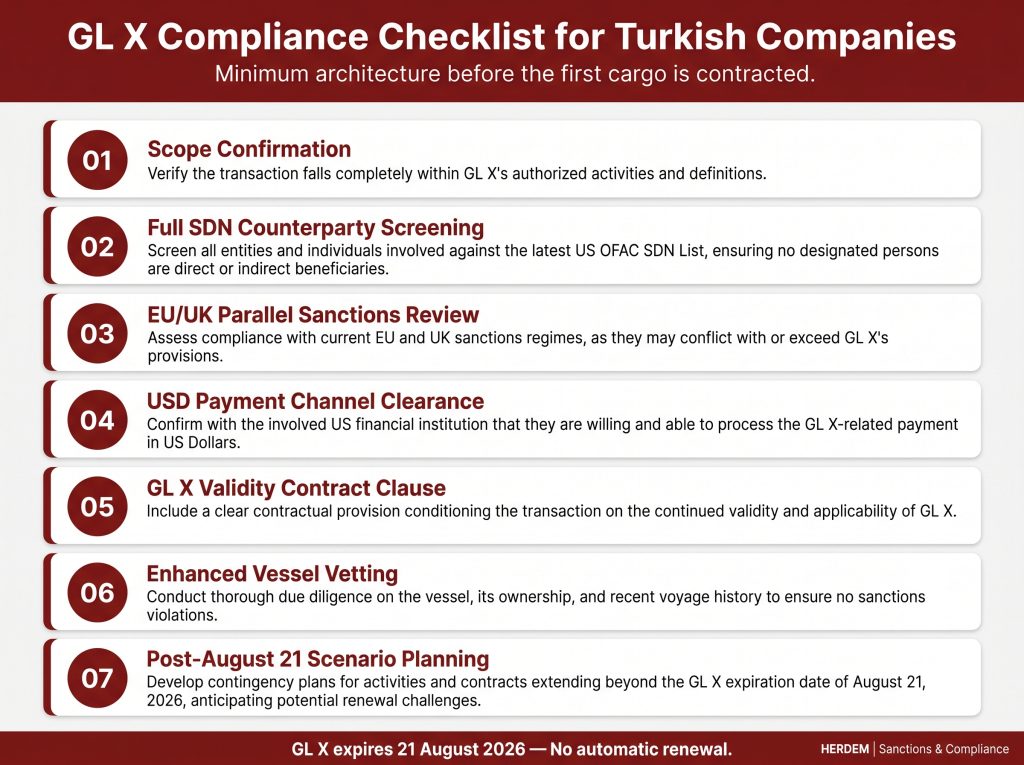
The companies that will benefit most from GL X are those that can move quickly on the commercial side while maintaining a contemporaneous compliance record. Speed without documentation is not a compliance program; it is an enforcement exhibit. The following framework is not exhaustive — specific transactions will require transaction-level legal analysis — but it reflects the minimum architecture a serious Turkish market participant should have in place before the first cargo is contracted.
The Timeline That Governs Everything
A Strategic Lens for Turkish Decision-Makers
The framing that matters for Turkish C-suites is not “can we do this?” — GL X has answered that question in the affirmative for authorized transactions. The framing that matters is “are we positioned to do this compliantly, and is the margin sufficient to justify the residual risk?”
For large Turkish refineries and state-adjacent energy entities such as TÜPRAŞ and BOTAŞ, the calculus is complex. These companies operate under the indirect oversight of the Turkish government, which has historically stated that it will not enforce unilateral U.S. sanctions on Iran. GL X does not require Turkish government authorization — it is a U.S. legal instrument that any market participant can rely on. But large Turkish state-adjacent entities also have significant exposure to international capital markets, European banking relationships, and credit ratings that are sensitive to sanctions-adjacent reputational risk. For these companies, GL X is a legal window, not a commercial instruction.
For mid-sized Turkish trading houses and shipping intermediaries — the segment of the market that has historically been most active in Iranian energy flows — GL X represents the clearest commercial mandate they have had in over a decade. Companies in this category that have already built compliance infrastructure, established non-contaminated payment corridors, and maintained clean OFAC records are structurally better positioned than those that have operated in opacity. The lesson of the February 2026 designations of Utuş, Arya, and Altis is not that Turkish intermediaries cannot participate in Iranian energy trade. It is that Turkish intermediaries who participate through newly incorporated shell entities with opaque ownership structures will be targeted. GL X rewards transparency and penalizes opacity.
For Turkish maritime companies — ship managers, operators, classification surveyors, insurers, and bunkering providers — the window may be the most commercially clean it has ever been. GL X covers the full maritime services stack without requiring transaction-specific analysis for each service. A Turkish ship manager can take on management of a blocked vessel carrying Iranian crude for the duration of the license without triggering SDN liability — provided the management relationship is itself for an authorized cargo transaction and does not implicate excluded jurisdictions or entities.
“GL X rewards transparency and penalizes opacity. Turkish companies that have built compliant infrastructure are structurally better positioned than those that have operated in the shadows.”
The Bottom Line
OFAC General License X is the most significant single sanctions authorization affecting Iranian petroleum trade in over a decade. It is also one of the most time-compressed: sixty days is not long enough to build a compliance program from scratch, establish new banking relationships, and execute meaningful volumes. Turkish companies that move quickly and compliantly stand to capture real commercial value. Those that move quickly and carelessly stand to face enforcement actions under a sanctions architecture that GL X has made, if anything, more clearly defined.
The diplomatic context should not be treated as a source of comfort. MOU frameworks have collapsed before. GL X can be revoked by OFAC before August 21 if the negotiations break down. The IRGC’s continued designation as a Foreign Terrorist Organization — unaffected by GL X — means that the criminal liability dimension of Iranian oil transactions has not been neutralized. And the EU and UK sanctions frameworks, which GL X cannot touch, remain a binding constraint for Turkish companies with European financial exposure.
The window is real. The opportunity is real. But it is a window that requires a lawyer to navigate, not a door left open by accident.